
The Future of Artificial Intelligence in the Next Five Years
A Strategic Outlook on Innovation, Disruption, and Opportunity — From 2026 to 2030
What if the job you’re preparing for today doesn’t exist in five years — or better yet, what if AI helps you create one that never existed before?
AI Is No Longer a Promise — It’s an Operating Reality
The conversation about artificial intelligence has shifted — irreversibly. For most of the previous decade, AI lived in research papers, keynote stages, and cautious pilot programs. Today, it runs logistics networks, drafts legal contracts, assists surgeons, powers search engines, and writes code. The question is no longer whether AI will transform our world. It already has. The question now is: how fast, how far, and who captures the value?
The next five years — 2026 through 2030 — represent what many researchers are calling the operational decade of AI. Generative AI, once a curiosity demonstrated through chatbots, is maturing into infrastructure. Machine learning models are becoming smaller, faster, and more specialized. Autonomous systems are moving from factory floors into financial markets, clinical settings, and creative industries. The window to prepare — for individuals, businesses, and governments — is narrower than most realize.
This report provides a structured, evidence-based outlook on the key AI trends, industries poised for transformation, the risks that accompany rapid adoption, and the concrete opportunities available to those willing to engage strategically. It is written for decision-makers, professionals, and curious minds who want more than hype — and are ready to act on what comes next.
Five AI Trends That Will Define 2030
The trajectory of AI development is rarely linear, but certain structural shifts are now visible enough to plan around. Here are the five forces most likely to reshape the landscape between now and 2030.
Generative AI Goes Mainstream
Beyond text and images — generative AI now produces video, music, 3D models, and executable code at production scale. Personalized content delivery becomes the standard, not the exception.
AI + Automation Redefines Work
Routine cognitive tasks are automated first. New hybrid roles emerge at the boundary of human judgment and machine execution. The professional landscape bifurcates between AI-literate and AI-passive workers.
Healthcare Enters a New Era
Predictive diagnostics, accelerated drug discovery, and AI-assisted virtual care compress timelines that once took decades. Early disease detection shifts from reactive to proactive.
Hyper-Personalization at Scale
Marketing, education, e-commerce, and financial services deliver real-time, individualized experiences. The era of broadcast content gives way to a model of one-to-one intelligence.
5. Regulation and Ethics Will Define Competitive Advantage
Perhaps the most underestimated trend: governments worldwide are no longer watching. The European Union’s AI Act, evolving U.S. frameworks, and emerging standards from China, India, and the Gulf states are creating a patchwork of compliance requirements that will directly affect product design, data architecture, and deployment timelines. Organizations that treat AI ethics as a legal checkbox will find themselves exposed. Those that embed transparency, fairness audits, and accountability structures into their AI systems early will carry a durable competitive advantage — both in consumer trust and regulatory agility.
Bias in training data, opaque decision-making in high-stakes contexts (lending, hiring, criminal justice), and the weaponization of generative AI for disinformation are not theoretical risks. They are active, documented challenges that the industry must address with the same urgency applied to model performance.
Industries That Will Be Transformed
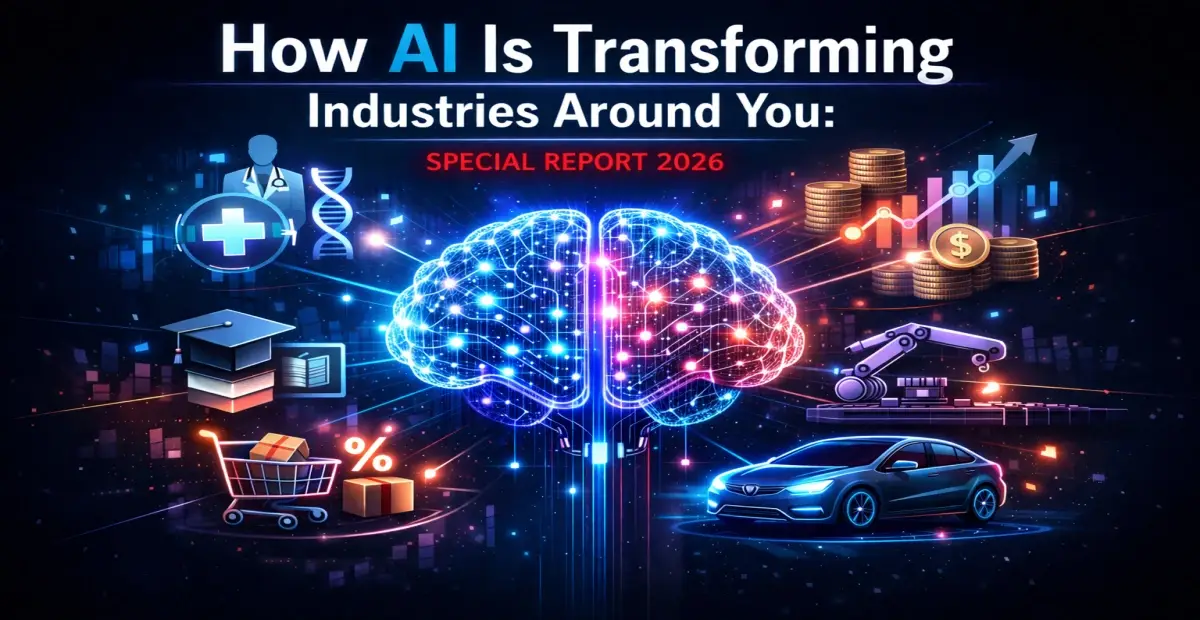
AI does not impact all sectors equally. The following industries are experiencing — or are on the precipice of — structural transformation, not merely incremental efficiency gains.
The Risks We Cannot Ignore
Any honest strategic outlook must account for the forces that could slow, distort, or reverse AI’s trajectory. The following risks are neither hypothetical nor distant — they are present-tense challenges requiring immediate attention from technologists, policymakers, and business leaders alike.
Where the Opportunity Lives
Risk and opportunity are two faces of the same transition. The organizations and individuals who navigate the next five years successfully will not be those who move fastest — they will be those who move most deliberately, with a clear-eyed view of where durable advantage lies.
For Individuals
- Develop AI prompt engineering and workflow design skills — the new professional literacy
- Build data literacy: understanding outputs, limitations, and confidence intervals of AI systems
- Migrate toward roles that require judgment, empathy, and contextual reasoning
- Invest in domain expertise — AI amplifies specialists, it doesn’t replace them
- Experiment continuously with AI tools in your current work before your industry mandates it
For Businesses
- Audit your workflows for AI augmentation potential before competitors do it for you
- Build proprietary data assets — data is the durable moat, not the model
- Invest in AI literacy across all levels, not just the technical team
- Adopt AI governance frameworks early to build trust with customers and regulators
- Prioritize AI strategies that compound over time: learning systems, not one-time deployments
What the World Looks Like in 2030
Predictions carry inherent uncertainty, but directional clarity has value. Based on current trajectories in research, deployment, and regulatory development, here is a grounded sketch of the AI landscape in 2030.
The next five years will not reward passive observers. They will reward those who engage early, learn continuously, and apply AI with intentionality and ethical grounding. The technology is consequential. So is the choice of how to meet it.
Start Learning AI Skills Today Explore AI for Your Business