
Key Takeaways
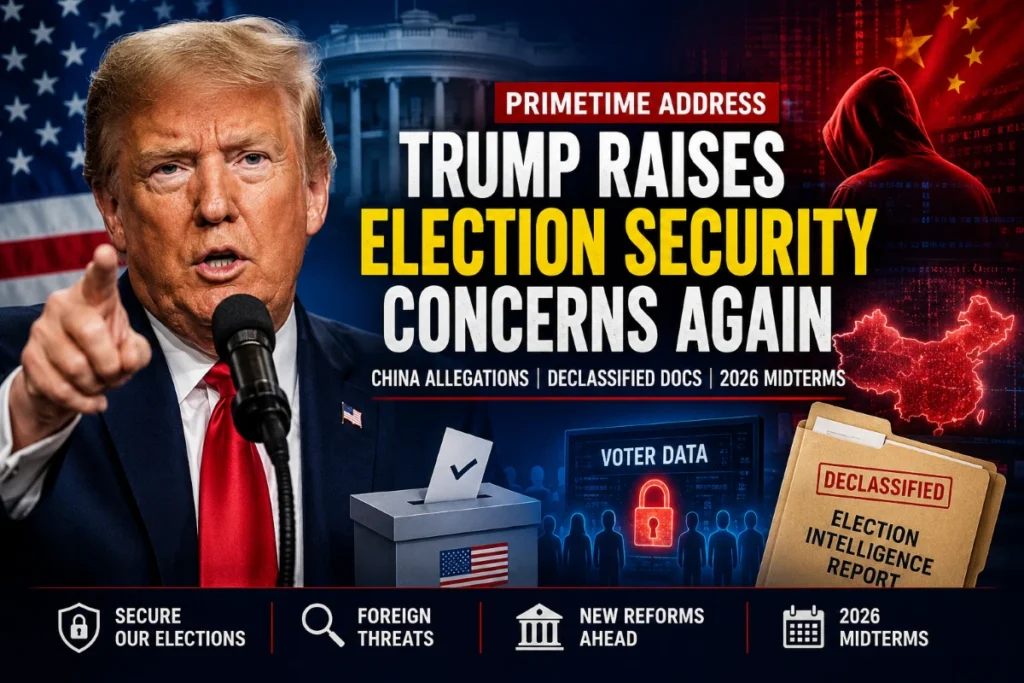
- President Donald Trump used a primetime White House speech to renew focus on election security.
- He claimed newly declassified intelligence shows China obtained data on millions of U.S. voters.
- China denied the allegations and called them fabricated.
- Previous intelligence assessments found no evidence that foreign interference altered the 2020 election outcome.
- Election security is expected to remain a major issue throughout the 2026 U.S. midterm election campaign.
Trump Revives Election Security Debate Ahead of 2026 Midterm Elections
President Donald Trump used a nationally televised primetime address from the White House to place election security back at the center of American political debate. Speaking just months before the 2026 U.S. midterm elections, Trump announced the release of newly declassified intelligence documents that he said reveal vulnerabilities in the country’s election systems and alleged that China gained access to personal data belonging to millions of American voters.
The speech quickly reignited one of the most divisive political issues in the United States. While Trump described the information as evidence of serious national security concerns, critics argued that many of his claims have already been examined by previous intelligence reviews. China also rejected the allegations, calling them unfounded and politically motivated.
Declassified Documents Become the Centerpiece of Trump’s Address
During the address, Trump said recently declassified intelligence contains information suggesting that Chinese actors collected extensive data on approximately 220 million American voters. According to the president, the documents demonstrate significant weaknesses in election infrastructure and justify stronger federal action to protect future elections.
Trump argued that election integrity remains a matter of national security rather than simply a political issue. He said protecting voter information and election systems should become a bipartisan priority regardless of party affiliation.
Although administration officials presented the documents as an important disclosure, they have not publicly produced evidence showing that foreign actors successfully altered vote counts or changed certified election results. Intelligence assessments released after the 2020 election similarly concluded that foreign governments did not alter the outcome of the presidential race.
Election Integrity Returns as a Major Campaign Theme
The speech reflects Trump’s continued effort to make election security one of the defining issues of the Republican campaign ahead of November’s midterm elections.
For several years, Trump has argued that weaknesses in voting systems undermine public confidence. During his remarks, he repeated calls for stricter voter identification requirements, improved citizenship verification, enhanced cybersecurity protections, and greater transparency throughout the election process.
Supporters say these proposals would strengthen public trust in elections, while opponents argue that many existing safeguards already protect election integrity and that widespread voter fraud remains extremely rare according to previous investigations.
The renewed focus also comes as Republicans attempt to energize their voter base before competitive congressional races across the country.
China Strongly Rejects the Allegations
Beijing responded quickly to Trump’s accusations.
Chinese officials denied any involvement in interfering with American elections and dismissed the allegations as entirely fabricated. A spokesperson for China’s Foreign Ministry said China has never attempted to influence U.S. elections and urged Washington to avoid politicizing bilateral relations.
The response adds another point of tension to an already complicated relationship between the world’s two largest economies. Although recent diplomatic efforts have attempted to stabilize U.S.-China relations, disagreements over technology, trade, cybersecurity, and national security continue to shape interactions between both governments.
ntelligence Findings Continue to Draw Debate
One of the most controversial aspects of Trump’s speech involves the interpretation of intelligence findings.
Trump argued that the newly released material demonstrates foreign efforts to exploit vulnerabilities in U.S. election systems. However, previous intelligence reviews—including assessments completed after the 2020 election—found no evidence that foreign interference changed vote totals or altered the election outcome.
Political analysts note that distinguishing between attempts to collect information, cyber espionage, influence campaigns, and direct election manipulation remains an important part of understanding election security. Cybersecurity experts have long warned that foreign governments routinely seek intelligence on political systems worldwide, but that activity does not necessarily mean election results were successfully manipulated.
Political Timing Draws Attention
The timing of the president’s address has also become part of the political discussion.
Trump delivered the speech as his administration faces growing scrutiny over economic challenges and international developments. Some observers believe emphasizing election security allows Republicans to return to an issue that has consistently motivated their supporters.
At the same time, Democrats criticized the speech, arguing that the administration continues to revisit claims that have previously been investigated. They maintain that election officials across both Republican- and Democratic-led states certified the 2020 results after multiple audits, recounts, and court proceedings.
Media Coverage Reflects the Controversy
The speech also generated discussion among major American broadcasters.
While some television networks carried the address live, others chose to stream it through digital platforms instead of broadcasting it on their primary channels. The decision reflected ongoing debates over how news organizations should handle presidential speeches involving disputed political claims while still fulfilling their responsibility to inform the public
Media analysts noted that presidential addresses have historically received broad television coverage, although editorial decisions increasingly vary depending on the subject matter.
Why Election Security Remains a National Issue
Regardless of political affiliation, election security continues to receive attention from policymakers, cybersecurity experts, and intelligence agencies.
Areas that experts commonly identify as priorities include:
- Protecting voter registration databases
- Strengthening cybersecurity defenses
- Preventing foreign cyber intrusions
- Improving transparency during vote counting
- Enhancing cooperation between federal and state election officials
While disagreements persist over the extent of foreign threats and the effectiveness of existing safeguards, there is broad consensus that securing election infrastructure remains an ongoing responsibility.
What Comes Next?
Trump indicated that his administration will continue pursuing additional election reforms and encouraged Congress to consider legislation designed to strengthen voter verification and election security standards. Whether those proposals gain enough bipartisan support remains uncertain.
The newly declassified documents are also likely to receive further examination from lawmakers, intelligence officials, cybersecurity specialists, and independent analysts in the coming weeks. Their interpretation could become a significant topic during the remainder of the 2026 campaign season.
As Americans prepare for another closely watched election cycle, debates over election integrity, cybersecurity, and foreign influence are expected to remain prominent in both political campaigns and public policy discussions.