
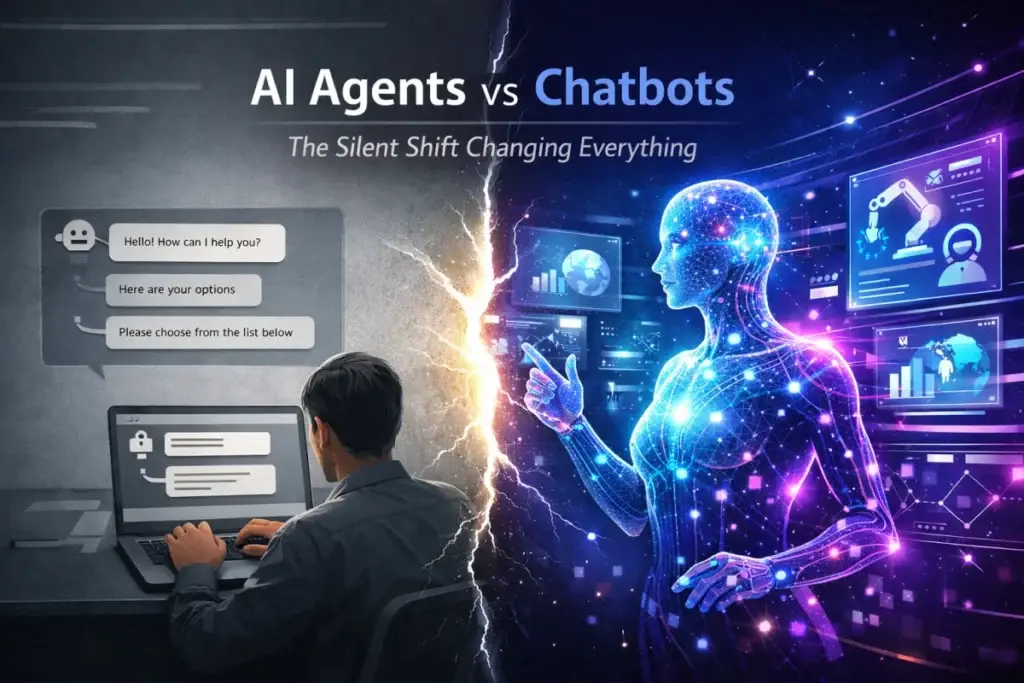
most people, when they imagine the AI revolution taking place around them, picture a smarter chatbot. A more articulate autocomplete. A search engine that talks back. They think of ChatGPT answering questions, a customer service bot handling complaints, or an assistant that writes emails a little faster than they could themselves. They are not wrong — but they are looking in completely the wrong direction.
The real shift is not happening in the conversation window. It is happening behind it. While users notice that AI has become more articulate, the underlying architecture is undergoing a transformation so fundamental that the word “chatbot” will soon sound as quaint as “electronic calculator.” We are moving — quietly, rapidly, and largely without announcement — from AI that responds to AI that acts.
The difference between a chatbot and an AI agent is not one of degree. It is a difference in kind — like the gap between a map and a GPS that drives the car itself.
AI Agents vs Chatbots: Core Differences
Before examining the scale of the shift, we need to be precise about what these two things actually are — not in marketing language, but in terms of what they fundamentally do and how they operate.
| Features | Chatbot | AI Agent |
|---|---|---|
| Mode | Responds when prompted; passive between inputs | Pursues goals through self-directed, sequential steps |
| Memory | Limited to the current conversation session | Maintains state and context across time and runs |
| Tools | Language generation only | Web, APIs, code execution, databases, file systems |
| Scope | Single exchange, single answer | Multi-step tasks spanning hours or days |
| Human role | Required at every step to continue | Sets goals and constraints; escalated only when needed |
Interaction vs Execution
A chatbot’s fundamental mode is dialogue. It processes your input, generates a response, and waits. Its entire existence is bounded by the exchange. An AI agent’s fundamental mode is execution. Given a goal, it breaks that goal into sub-tasks, selects appropriate tools, takes real-world actions, evaluates results, and adjusts course. The conversation — if there is one — is incidental, just one channel through which work occasionally passes.
Reactive vs Proactive Behavior
Chatbots are, by design, entirely reactive. They have no ambient awareness, no persistent monitoring, no capacity to decide on their own that now is the right moment to act. They answer when called. AI agents can be genuinely proactive: monitoring a data stream and triggering an action when a threshold is crossed, checking in on a long-running process, or initiating communication because a pre-set condition has been met. They can, in a meaningful sense, notice things.

Single Task vs Multi-Step Autonomy
When you ask a chatbot to help you plan a marketing campaign, it produces a plan. When you ask an AI agent to execute one, it searches for audience data, drafts and tests copy variations, schedules posts through an API, monitors engagement metrics, and iterates — all without being prompted at each step. The distinction sounds subtle. Its operational implications are anything but. Entire categories of knowledge work that currently require sustained human attention become, in principle, fully delegatable.
Static Responses vs Context Awareness
A chatbot’s context is the conversation transcript — largely self-contained per session. An AI agent’s context is dynamic and cumulative: it integrates information from prior runs, external databases, real-time signals, and the outcomes of its own previous actions. It builds a working model of a situation over time, rather than snapping a picture and responding to it.
Human Dependency vs Independent Operation
The most consequential distinction: chatbots are always in a holding pattern, waiting for the next human input to proceed. Agents can be initialized with a goal and a set of constraints, and will work toward that goal autonomously — until it is achieved, until they encounter a decision requiring human judgment, or until they are stopped. The human is not a constant presence in the loop. They are a stakeholder who receives updates when something important happens.
Why This Shift Is “Silent” but Massive
If the transition from chatbots to AI agents is as significant as argued above, why does it not feel like a revolution in progress? Why isn’t everyone talking about it? The answer lies in how genuinely transformative infrastructure changes always unfold — not with an announcement, but through a slow accumulation of quiet substitutions.
| 73% of enterprise AI investment in 2025 targeting agentic workflows | 10× estimated productivity multiplier for knowledge workers with agent-assisted pipelines | 2027 projected year agent-driven software outpaces traditional SaaS adoption |
Gradual Integration Into Existing Systems
AI agents are not arriving as a single product you download and install. They are being woven into CRMs, ERP systems, development pipelines, customer support platforms, and financial tools — typically marketed under anodyne terms like “automation,” “workflow intelligence,” or “smart assist.” The underlying architecture is agentic. The branding is deliberately familiar. Companies adopting these systems rarely describe the change in AI-theoretical terms. They say they are “automating the sales pipeline” or “streamlining onboarding.” Both are true — and both obscure the magnitude of what has actually been introduced.
The Future: From Assistants to Autonomous Ecosystems
If the present represents the early-stage integration of AI agents into existing workflows, the trajectory forward is striking. Extrapolating from current architectural trends and real-world adoption patterns, the near future looks less like “AI-enhanced software” and more like software rebuilt from the ground up around autonomous action.

AI Agents Replacing Entire Software Layers
The end state for many categories of enterprise software is not “software augmented by AI agents.” It is “AI agents with a thin interface.” Consider a typical modern marketing stack: a CRM, an email platform, an analytics tool, an A/B testing system, a content management system, a scheduling tool — all connected by integrations that themselves require ongoing maintenance. An agentic system needs almost none of this infrastructure. It needs data, goals, constraints, and channels. The intermediary software layer — which exists primarily to make complex operations manageable for humans — becomes largely redundant when the system can manage the complexity itself.
Human + Agent Collaboration Models
None of this implies the immediate or uniform elimination of human roles. What emerges instead is a new collaboration model in which humans operate at a higher level of abstraction. Rather than executing workflows, humans define goals, set constraints, evaluate outputs, exercise value judgments, and handle genuinely novel situations that fall outside an agent’s domain of competence. Work becomes more strategic and less procedural. This is, in one sense, exactly what every generation of automation has promised. The difference this time is the breadth of cognitive skills being automated — and the speed at which the frontier is advancing.
The Rise of Multi-Agent Systems
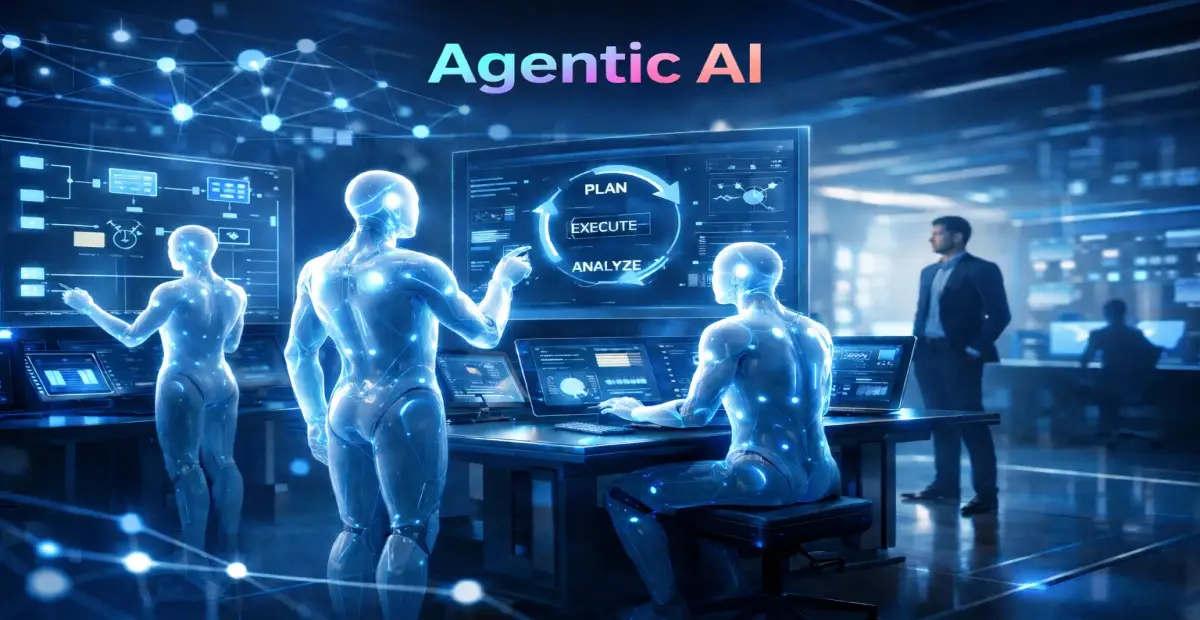
Perhaps the most consequential near-future development is not individual AI agents becoming more capable in isolation, but multiple agents working in structured coordination. In a multi-agent architecture, a coordinating agent breaks a complex goal into sub-goals and delegates them to specialized agents — a research agent, a writing agent, a coding agent, a quality assurance agent — whose outputs are synthesized into a final result. The combined capability of a well-orchestrated multi-agent system is not additive but multiplicative. Tasks that would be intractable for any single AI system — or any single human team — become achievable at previously impossible speed and scale.
Conclusion: It’s Not Just Better Chatbots — It’s a New Paradigm
Let us be precise about what has been argued here. The difference between a chatbot and an AI agent is not the difference between a basic calculator and a scientific one. It is the difference between a calculator and a system that decides what to calculate, executes the calculation, interprets the result, and takes action based on it — without being prompted at each step.
Chatbots are interfaces. Agents are actors. Chatbots extend human communication. Agents extend human agency. The distance between those two things — between communication and agency — is not a gap in sophistication. It is a gap in kind. And it is enormous.
The shift is silent because transformation at the infrastructure level always is. We did not notice the internet rewriting commerce until it already had.
The reason this shift remains underappreciated is precisely that it is happening in the unglamorous middle layers of enterprise systems — in backend workflows, in API calls, in automated pipelines that users never directly interact with. The interface can remain a familiar chat window even as the system behind it has fundamentally changed in what it is capable of doing and becoming.
That silence should not be mistaken for smallness. The transition from conversational AI to agentic AI is, in scope and implication, comparable to the transition from static web pages to dynamic web applications — a change that remade entire industries, created entirely new ones, and altered the structure of daily life in ways no one fully anticipated at the outset.
We are in the early chapters of an equivalent transition. The chatbot era taught us that AI could talk. The agent era will demonstrate that AI can work. And the distance between talking and working — between a tool and a colleague — is the entire distance between what we have today and what comes next.