
In 2026, this shift from automation to autonomy is no longer theoretical. Businesses are deploying AI agents to handle customer support, generate leads, manage internal operations, write and deploy code, and conduct deep research—end to end. The question is no longer whether to adopt agentic AI, but which platform to build on.
What Makes an AI Platform “Agentic”?
Before diving into the tools, it’s worth understanding what separates a true agentic platform from a standard AI chatbot or basic automation tool. An agentic AI platform typically offers:
- Goal-oriented reasoning — the ability to plan multi-step tasks toward an objective
- Tool use — the ability to browse the web, write code, call APIs, or interact with external services
- Memory and context — retaining relevant information across steps or sessions
- Feedback loops — self-correcting based on results
- Human-in-the-loop optionality — knowing when to pause and ask for approval
Not every platform on this list checks every box—but each represents a meaningful step toward autonomous AI operation.

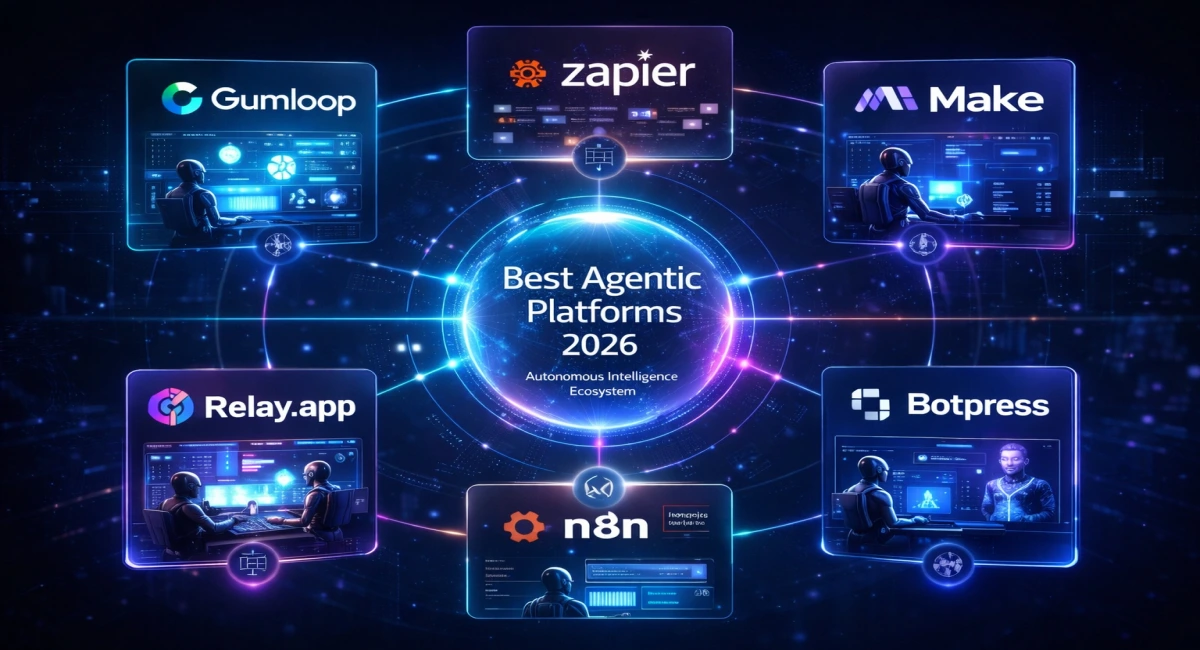
Top Agentic Platforms in 2026
Botpress
Botpress is one of the most mature AI agent platforms available today, originally built as an open-source chatbot framework and now evolved into a full-featured conversational AI and agent-building platform. It combines a powerful visual flow builder with large language model integrations, making it a strong choice for teams that need structured, reliable agent behavior in customer-facing environments.
Key Features
Botpress offers a drag-and-drop conversation studio, native integrations with GPT-4, Claude, and other LLMs, multi-channel deployment (web, WhatsApp, Slack, SMS), a knowledge base with retrieval-augmented generation (RAG), and built-in analytics. Its agent-building capabilities include multi-turn memory, conditional logic, and tool-calling via APIs.
Strengths
Botpress excels at structured conversational workflows. If you need an AI agent that reliably follows a defined path—escalates to a human when uncertain, collects specific information, and integrates with a CRM—Botpress handles this better than almost any competitor. Its open-source roots mean a strong developer community and extensive documentation.
Limitations
Botpress is less suited for highly unstructured, reasoning-heavy tasks. While it integrates LLMs well, it is fundamentally a conversation-first platform. Teams needing deep reasoning chains or complex multi-step autonomous tasks may find it limiting without significant customization.
Best For
Customer support automation, lead qualification bots, internal helpdesks, and structured conversational agents where reliability and channel coverage matter.
Claude (by Anthropic)
Claude occupies a unique position in the agentic AI landscape: it is both a frontier AI model and a platform for building sophisticated reasoning agents. Unlike purpose-built automation tools, Claude’s value comes from its exceptional depth of understanding, long-context reasoning, and ability to tackle ambiguous, multi-layered problems that would trip up simpler systems.
Key Features
Claude’s most compelling capabilities for agentic use include an industry-leading 200K token context window, enabling it to process entire codebases, legal documents, or research corpora in a single session. The Artifacts feature allows Claude to produce structured, standalone outputs—code, documents, analyses—that can be acted upon immediately. Its advanced reasoning means it can decompose complex objectives, identify gaps in logic, and self-correct without needing rigid workflow definitions.
Through the Anthropic API, Claude supports tool use, function calling, and multi-agent orchestration, making it a powerful backbone for custom agent architectures. Claude can serve as both an orchestrator directing other agents and as a specialist sub-agent executing specific tasks.
Use Cases
Claude shines in knowledge-intensive agent workflows: research agents that synthesize hundreds of sources, coding agents that debug and refactor entire repositories, document analysis agents that extract structured insights from unstructured data, and decision-support agents that reason through complex business scenarios.
Best For
Teams building reasoning-heavy custom agents, developers needing a powerful LLM backbone for multi-agent systems, and knowledge workers who need an AI that can handle nuance, ambiguity, and long-form content without losing coherence.
n8n
n8n (pronounced “n-eight-n”) is an open-source workflow automation platform that has become the go-to choice for developers who want granular control over their AI agent pipelines. While it started as a Zapier alternative, n8n has matured into a serious agentic orchestration layer, particularly for backend and data-intensive workflows.
Key Features
n8n offers a node-based visual workflow builder, self-hosting options (critical for data-sensitive organizations), native AI agent nodes with LLM integration, vector database connectors, and HTTP request nodes for calling any API. Its AI Agent node supports tool calling, memory, and multi-step reasoning chains natively.
Strengths
n8n’s greatest strength is its flexibility. Because it is open-source and self-hostable, developers can build arbitrarily complex pipelines, integrate with any service via API, and maintain full data sovereignty. For organizations with strict compliance requirements, this is often a deciding factor. The platform’s growing library of community templates accelerates agent development significantly.
Limitations
n8n has a steeper learning curve than visual-first platforms. Non-technical users will struggle without developer support, and debugging complex workflows can be time-consuming. The hosted cloud version is cost-effective at small scale but can become expensive for high-volume automations.
Best For
Developer teams building complex backend AI pipelines, organizations requiring self-hosted infrastructure, and technical users who need maximum flexibility in connecting AI models to data sources and services.
Make (formerly Integromat)
Make is a visual automation platform that sits comfortably between the developer-focused n8n and the simplicity-first Zapier. With its distinctive “scenario” model—where data flows through interconnected modules on a visual canvas—Make strikes a balance between power and accessibility that has won it a large and loyal user base among operations teams and technical non-developers.
Key Features
Make offers hundreds of pre-built app integrations, an AI tools module for calling LLMs, conditional logic and routing, real-time data processing, and robust error handling. Its agentic capabilities are “semi-agentic”—you can build workflows that incorporate AI decision-making, but fully autonomous multi-step agent loops require more manual configuration compared to dedicated agent platforms.

Strengths
Make’s visual interface makes complex workflows comprehensible. Unlike Zapier’s linear trigger-action model, Make’s canvas view lets you see branching logic, iterations, and conditional paths at a glance. It handles high data volumes efficiently and offers more sophisticated data transformation than Zapier.
Limitations
While Make integrates AI well at the decision and data-processing layer, it is not purpose-built for agentic loops. Building a true autonomous agent in Make requires creative workarounds. It is also a closed, cloud-hosted platform, which can be a limitation for data-sensitive teams.
Best For
Operations teams, marketers, and technical business users who need sophisticated automation with AI decision-making embedded in structured business workflows—particularly in e-commerce, CRM automation, and marketing operations.
Zapier
Zapier is the undisputed king of no-code automation in terms of sheer breadth. With over 6,000 app integrations, Zapier has been the default choice for business users who need to connect tools without writing code. In recent years, Zapier has moved aggressively into AI with its “Zaps with AI” features and Zapier Agents product, attempting to extend its platform into true agentic territory.
Key Features
Zapier offers its massive integration library, AI actions that can interpret and respond to natural language triggers, Zapier Agents for autonomous multi-step task execution, Tables for lightweight data storage, and Interfaces for building simple front-end forms and dashboards.
Strengths
Zapier’s overwhelming advantage is accessibility. If your primary criterion is ease of setup and breadth of integrations, nothing comes close. Non-technical users can be productive on Zapier within hours. The new Agents feature is genuinely useful for simple autonomous tasks like managing email workflows, scheduling, or routing support tickets.
Limitations
Zapier’s agentic capabilities, while improving, lag behind purpose-built agent platforms in depth and reliability. Complex reasoning chains, long-context memory, and sophisticated tool orchestration are not its strengths. At scale, Zapier can also become surprisingly expensive given its task-based pricing model.
Best For
Small businesses, solo operators, and non-technical teams who need to connect many apps quickly and want basic AI-augmented automation without significant configuration overhead.
Relay.app
Relay.app is one of the most thoughtfully designed platforms in this list, built from the ground up with an AI-first and human-in-the-loop philosophy. Where most automation platforms treat human intervention as an afterthought—a fallback when something goes wrong—Relay treats human judgment as a first-class feature of the workflow.
Key Features
Relay offers AI-powered workflow steps, structured human approval gates, collaborative workspaces where teams can review and act on AI outputs, an intuitive visual builder, and a clean, modern interface designed for team adoption. It integrates with popular business apps and can incorporate LLM reasoning steps at any point in a workflow.
Strengths
Relay’s human-in-the-loop design is genuinely differentiated. For workflows where you want AI to do the heavy lifting but a human to make the final call—approving a contract, confirming a customer refund, reviewing a generated report—Relay makes this experience seamless. The platform is also notably well-designed, with an interface that encourages team adoption rather than resistance.
Limitations
Relay is newer and has a smaller integration library than Zapier or Make. It is not the right choice for fully autonomous workflows where human touchpoints are not desired. The platform is also less suited for developer-heavy technical pipelines.
Best For
Teams running high-stakes business workflows where AI handles research, drafting, or data processing, and humans handle final approval—legal teams, finance departments, content operations, and customer success teams.
Gumloop
Gumloop is the most approachable entry on this list, designed explicitly for non-technical users who want to build and deploy AI agents without writing a single line of code. Its drag-and-drop interface, clean visual design, and focus on rapid prototyping have made it a favorite among solopreneurs, startup founders, and business teams exploring agentic AI for the first time.
Key Features
Gumloop offers a node-based visual canvas, pre-built AI agent templates, integration with popular LLMs, web scraping nodes, document processing capabilities, and a growing library of connectors. Workflows are built by connecting blocks—inputs, AI steps, conditions, and outputs—in a way that feels more like building with Lego than writing software.
Strengths
Gumloop’s accessibility is its superpower. The time from “sign up” to “working AI agent” is measured in minutes, not days. It is ideal for quickly prototyping agent concepts, validating ideas, and building lightweight production workflows without engineering resources.
Limitations
Gumloop’s power ceiling is lower than developer-focused platforms. Complex data transformations, high-volume processing, and sophisticated multi-agent orchestration will push the platform to its limits. For production-scale, reliability-critical workflows, more robust platforms are needed.
Best For
Non-technical founders, content creators, small business owners, and teams exploring agentic AI for the first time—anyone who values speed and simplicity over depth and scalability.

Platform Comparison Table
| Platform | Agentic Level | Best For |
|---|---|---|
| Botpress | High | Conversational agents & chatbots |
| Claude | Very High | Reasoning agents & knowledge work |
| n8n | High | Developer-grade backend pipelines |
| Make | Medium | Business process automation |
| Zapier | Medium | Beginner-friendly integrations |
| Relay.app | Medium | Team workflows with human oversight |
| Gumloop | Medium | No-code agent prototyping |
Which Agentic AI Platform Should You Choose?
The honest answer is that there is no universal winner—the best platform depends entirely on your use case, technical capacity, and scale requirements. Here is a practical breakdown:
For developers and engineering teams: n8n or Botpress. If you have engineering resources and need maximum control, customizability, and the ability to self-host, n8n is the clear choice for backend pipelines. Botpress is the better option when conversational interfaces are central to the use case.
For non-technical users and small teams: Gumloop or Zapier. If you need to move fast without a developer, start with Gumloop for AI-native agent building or Zapier for connecting existing tools. Both can deliver genuine value with minimal setup time.
For deep AI reasoning and complex cognitive tasks: Claude. When the work is intellectually demanding—synthesizing research, reasoning through ambiguous problems, generating reliable long-form outputs, or acting as the brain of a multi-agent system—Claude’s reasoning capabilities are in a different league.
For business process automation with AI embedded: Make or Relay.app. If you are automating structured business operations—lead routing, document processing, approval workflows—Make offers power and visual clarity, while Relay excels when human judgment needs to be woven into the process.
For enterprise teams with compliance requirements: n8n (self-hosted) or Botpress (enterprise). Data sovereignty, audit trails, and security controls become critical at scale, and these platforms offer the deployment flexibility to accommodate them.
The Future of Agentic AI: 2026–2028
The platforms reviewed here represent the current state of the art—but the trajectory of agentic AI suggests even more dramatic changes ahead.
Multi-agent collaboration will become the dominant architecture. Rather than single agents handling tasks end-to-end, networks of specialized agents will collaborate—a researcher agent handing findings to an analyst agent, which hands recommendations to an executor agent—with orchestration layers managing the handoffs.
Autonomous business functions are already emerging. Early adopters are deploying agents that handle entire business functions—not just tasks within functions—with humans setting strategy and reviewing outcomes rather than managing individual workflows.
AI-native SaaS will displace traditional tools. Many of the integrations that platforms like Zapier and Make facilitate today exist because legacy SaaS tools were not designed with AI in mind. New software built natively for AI interaction will reduce the need for integration middleware, reshaping this market significantly.
Workflow building will become conversational. The drag-and-drop canvas, the node editor, the trigger-action interface—these are interim UX paradigms. In the near future, describing what you want an agent to do in natural language will be sufficient to instantiate a working workflow, with the platform handling implementation automatically.
Conclusion: Build Your Stack, Not Someone Else’s
If you are looking for the single best agentic AI platform in 2026, you will not find it—because it does not exist. Every platform reviewed here excels in specific contexts and falls short in others. The most sophisticated organizations are not choosing one tool; they are composing stacks.
A representative example of a thoughtful agentic stack in 2026: Claude for reasoning and knowledge work, n8n for orchestrating backend pipelines, Botpress for customer-facing conversational agents, and Relay.app for cross-functional workflows that require human checkpoints. Each tool doing what it does best, connected through APIs, producing an architecture that is greater than the sum of its parts.
The most important thing you can do is start experimenting. Spin up a free account on two or three platforms from this list. Build a simple agent. Deploy it. Observe where it breaks. The gap between understanding agentic AI conceptually and building with it practically closes faster than almost anything else in technology—but only if you start.
The autonomous era is not coming. It is here. The only question is whether your organization will lead the transition or play catch-up.