
The era of half-measures is over. Here’s what the best AI automation tools can do for you—and how to choose the right ones.
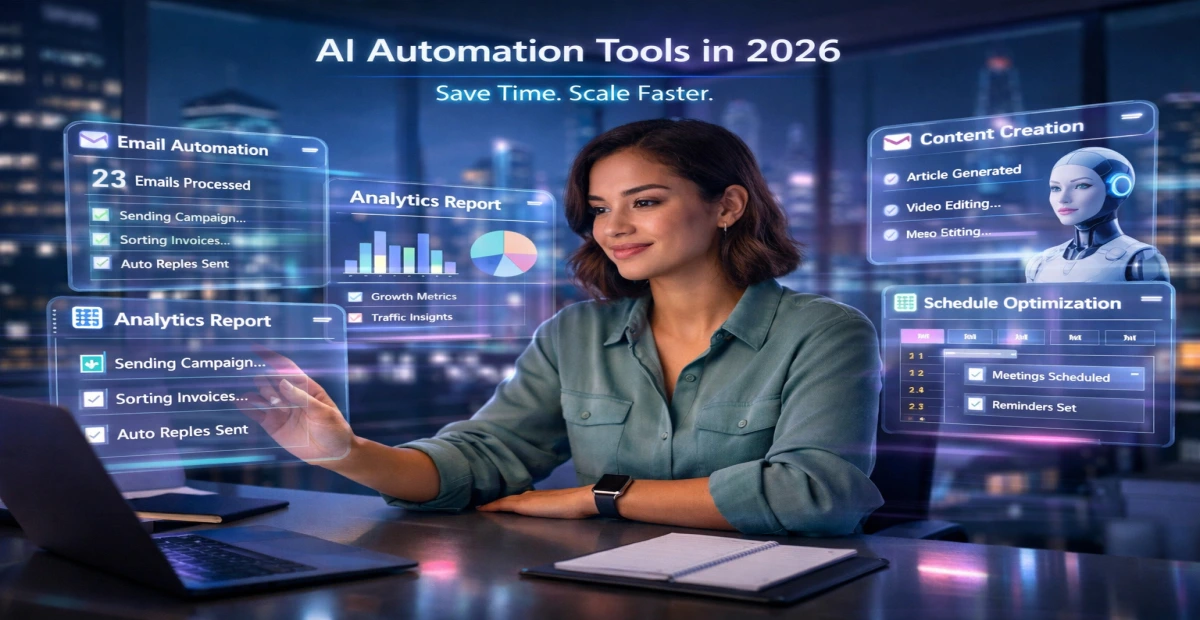
What if you could automate 70% of your daily tasks and spend the rest of your week on work that actually moves the needle?
In 2026, that’s no longer a thought experiment—it’s a practical reality for millions of professionals who’ve embraced AI automation.
Most businesses and individuals are still burning hours on work that should already be running itself: manual data entry, repetitive email drafts, copy-paste workflows, and decisions that a well-configured system could make in seconds. This isn’t just inefficient. It’s a structural disadvantage in a world where your competitors are already automating at scale.
This guide breaks down exactly what AI automation tools can do in 2026, which ones are worth your time, and how to build a strategy that compounds over months—not just saves you an hour this week.
What Is AI Automation in 2026?
AI automation has evolved well beyond the simple “if this, then that” logic of early workflow tools. Today’s systems are agentic—they can plan, reason, chain multiple tasks together, and adapt based on outcomes, all with minimal human oversight.
The key leap has been the move from rule-based automation toward systems with genuine memory and multi-tool orchestration. An AI agent in 2026 doesn’t just send an email when a form is submitted. It can draft the email, check your CRM for context, schedule a follow-up based on the recipient’s timezone, and log the interaction—all autonomously.
The ecosystem is led by a handful of major players: OpenAI, Google DeepMind, and Anthropic are pushing the frontier of model capability, while platforms like Zapier have become the connective tissue that routes AI intelligence across hundreds of business tools.
The shift in 2026
AI is no longer a tool you reach for. It’s a teammate that runs in the background — a quiet operator handling the work you used to dread.
Why This Matters Now
The argument for AI automation used to be efficiency. Now it’s survival. Businesses that automate intelligently don’t just save time—they compound their output. Every hour reclaimed from low-leverage work becomes an hour spent on strategy, relationships, and the kind of judgment that AI still can’t replicate.
30+
Hours Saved Weekly
3×
Faster Execution
0
New Hires Needed
↑
Accuracy & Consistency
The numbers are compelling, but the strategic insight is more important: AI is shifting from a tool into a role. The most forward-thinking organizations aren’t asking “what can we automate?” They’re asking “what should humans still own?”
The Categories of AI Automation
Not all automation is built the same. Understanding the landscape helps you pick the right instrument for the job rather than forcing a single tool to do everything.
Workflow automation platforms
These are the backbone of business automation—platforms like Zapier and Make that connect your apps and route data between them without writing a line of code. They’ve matured significantly, now supporting conditional logic, AI-powered decision branches, and native integrations with major AI models.
AI writing and content automation
Blogs, social posts, email sequences, product descriptions—generative AI tools have become reliable first-draft engines. The best practitioners don’t use them to replace thinking; they use them to eliminate the blank page and compress the time from idea to polished output.
AI coding and developer tools
GitHub Copilot and its contemporaries have fundamentally changed the pace of software development. Experienced developers report spending far less time on boilerplate and repetitive patterns, freeing cognitive capacity for architecture and problem-solving.
AI agents and task automation
This is the frontier. Autonomous agent frameworks can execute multi-step tasks—researching a topic, synthesizing findings, drafting a report, and emailing it to stakeholders—with a single high-level instruction. They’re still maturing, but the trajectory is clear.
Business process automation (BPA)
Enterprise-grade automation for CRM management, HR workflows, and financial processing. Salesforce’s AI tools, for instance, can now handle lead scoring, pipeline forecasting, and customer outreach with a level of sophistication that previously required dedicated analyst time.
The Top AI Automation Tools in 2026

ChatGPT
Now with persistent memory and native agent capabilities, ChatGPT has evolved from a conversational tool into a genuine workflow partner. It can draft content, make decisions, execute tasks across connected apps, and remember context from previous sessions—making it uniquely powerful for managing complex, recurring projects.
Best for: Individuals and teams who want a single AI layer across their daily work.

Zapier
The gold standard for connecting apps without code, Zapier now integrates AI to enable natural-language workflow creation. Users can describe processes in plain English and instantly turn them into automated workflows across thousands of apps.
Best for: Business owners and teams automating operational workflows.

Make
Where Zapier prioritizes accessibility, Make prioritizes power. Its visual builder enables complex workflows with branching logic, deep integrations, and precise data control.
Best for: Technical users and teams managing complex automation systems.

GitHub Copilot
GitHub Copilot has become an essential tool for modern software teams. Beyond code completion, it assists with documentation, test generation, code reviews, and debugging explanations—helping developers move faster with higher accuracy.
Best for: Developers seeking faster, higher-quality code output.
AI Agent Platforms
AI agent platforms represent one of the fastest-growing categories in AI. They allow users to define goals in natural language while the system plans and executes multi-step workflows—leveraging tools, browsing the web, writing code, and integrating with external services.
Best for: Advanced users, startups, and teams building complex automation systems.
Real-World Use Cases
Automation strategy looks different depending on who’s deploying it. Here’s how it plays out across three contexts:
For businesses
Automated customer support systems now handle the majority of tier-one queries without human escalation. Lead generation pipelines enrich, score, and route new contacts before a salesperson ever sees them. Data processing workflows that once required a full-time analyst run overnight and deliver polished reports by morning.
For individuals
Content creators are building publishing pipelines that take a raw idea from research to a formatted, scheduled post with minimal manual steps. Freelancers automate client onboarding, invoice follow-ups, and project updates. Knowledge workers use AI tools to triage email, summarize meetings, and surface action items automatically.
For teams
Project management automation handles task assignment, deadline tracking, and status reporting. Cross-tool integrations keep data synchronized across CRM, project management, and communication platforms without anyone manually updating spreadsheets. Reporting dashboards pull live data and generate narrative summaries ready for stakeholder review.
“The sooner you adopt AI automation, the faster you move from working harder to working smarter.”
2026 PRODUCTIVITY BENCHMARK
How to Choose the Right Tool
The best AI automation tool isn’t the most powerful one—it’s the one that maps cleanly to your specific problem. Here’s a practical framework for making the decision:
DEFINE YOUR GOAL
Are you trying to save time, scale operations, or remove bottlenecks? Your objective determines the right automation approach.
CHECK INTEGRATIONS
Ensure your tools connect seamlessly. The value of automation depends on how well it integrates with your existing stack.
COMPLEXITY VS EASE
Powerful tools offer flexibility, while simpler ones prioritize speed. Choose based on your technical needs and workflow complexity.
PRICING VS ROI
Measure the value of time saved. Most automation tools justify their cost quickly when applied effectively.
DATA PRIVACY
Understand how your data flows and ensure compliance with relevant regulations and security requirements.
START SMALL
Begin with one workflow before scaling. A solid foundation prevents complexity and improves long-term results.
Challenges Worth Knowing
AI automation is powerful, but it isn’t without friction. Over-automation is a genuine risk—systems that run without oversight can propagate errors at scale, and the cost of catching a mistake in an automated pipeline is often higher than catching it manually.
There’s also the learning curve. Advanced tools like agent frameworks require meaningful investment in understanding prompting, workflow design, and failure modes. Treating automation as a set-and-forget system is a common mistake that leads to brittle workflows and eventual rework.
Data security remains a material concern. When your workflows pass sensitive customer or financial data through third-party platforms, you need a clear picture of how that data is stored, processed, and retained. Audit your automation stack as you would any vendor relationship.
What’s Coming Next
The trajectory from here is toward full autonomy. Fully autonomous AI agents—systems that manage entire workflows independently, surfacing only the decisions that genuinely require a human—are already in early deployment at scale in forward-looking organizations. The timeline to widespread adoption is shorter than most expect.
Personalized AI copilots, tuned to specific roles and equipped with organizational context, will become standard infrastructure—less a tool you use, more a capability that runs alongside every knowledge worker. Integration across digital systems will deepen until the boundaries between applications, agents, and workflows become effectively invisible.
The professionals who thrive in this environment won’t be those who resist automation—they’ll be those who learn to direct it well.
The Bottom Line
AI automation is no longer a competitive advantage. It’s the baseline. The gap between organizations that automate intelligently and those that don’t is widening every quarter—and it’s visible in output, speed, and headcount efficiency.
Start with one workflow. Choose the tool that fits it cleanly. Automate it end-to-end, validate it, and scale from there. The compounding effect of reclaimed hours is extraordinary when you’re consistent—and the alternative is increasingly hard to justify.