
The era of the one-person empire is here — and it runs on agents, not employees. Here’s what that actually looks like in practice.
73%
Of online businesses using
AI agents by 2026
$4.2T
Global value unlocked by
autonomous AI workflows
18hrs
Average daily operation —
fully automated
The Shift to Autonomous Online Businesses
Not long ago, running an online business meant long hours, hired help, and a relentless to-do list that never quite emptied. You wrote the content, sent the emails, answered the support tickets, tracked the expenses, and managed the campaigns. If you were lucky, you outsourced some of it. If you were skilled, you automated a piece or two. But the heavy lifting was always yours.
That era is ending. Quietly, decisively, and faster than most people realize, AI agents are taking over the operational layer of online businesses — not as assistants that wait for commands, but as autonomous systems that identify what needs to be done, decide how to do it, and execute without being asked. The business owner’s role is shifting from operator to architect, from doer to designer.
This isn’t the chatbot revolution of 2023 or the automation hype of 2024. What’s happening in 2026 is structurally different. We now have AI systems that reason across multiple steps, retain memory between sessions, use real tools to affect the world, and correct their own mistakes mid-task. The result is a new category of business infrastructure — one that can run a meaningful portion of your operations while you sleep.
“The most consequential shift in business isn’t which tools you use. It’s whether your business can act without you. In 2026, the answer, increasingly, is yes.”
The 2026 tipping point isn’t accidental. Three forces converged simultaneously: the reliability of large language models crossed an enterprise-grade threshold, the cost of inference dropped dramatically, and a new generation of orchestration frameworks made it practical to chain agents together into coherent workflows. The result is a moment where early adopters aren’t just saving time — they’re running fundamentally different kinds of businesses than their competitors.
What Are AI Agents and How Do They Work?
The term gets used loosely, so let’s be precise. An AI agent is a software system that uses a large language model as its reasoning core and connects that reasoning to a set of tools and a defined goal. Unlike a simple chatbot — which responds to a single prompt and forgets everything afterward — an agent persists, plans, takes action in the real world, observes the results, and adjusts its approach accordingly.
Four components distinguish a true agent from a sophisticated autocomplete system:
Memory is what allows an agent to accumulate context across time. Short-term memory holds the current task’s details. Long-term memory, typically stored in a vector database, lets an agent retrieve relevant information from past interactions — a customer’s history, a brand voice guide, previous campaign results. Without memory, every agent session starts from zero. With it, agents compound in value the longer they run.
Reasoning is the ability to decompose a complex goal into a sequence of steps, choose between approaches, and handle unexpected obstacles without human intervention. This is where the LLM at the core earns its place. Given a goal like “increase trial-to-paid conversion by 15%,” a reasoning-capable agent can plan a multi-week test sequence, identify the variables to change, execute the changes, and evaluate results — all as a coherent chain of thought.
Tools are what connect reasoning to action. A bare LLM can think but can’t do. Tools — web search, code execution, database queries, API calls, browser control, email sending — give agents the ability to reach into the world and change it. The richness of an agent’s tool set determines the breadth of tasks it can complete autonomously.
Autonomy is the culmination: the degree to which an agent can operate on a goal without requiring step-by-step human instruction. Low-autonomy systems ask for approval at every decision point. High-autonomy agents operate independently until they hit a genuinely ambiguous situation, flag it for human review, and continue on everything else. The difference in productivity between these two modes is staggering.
The Evolution: From Manual Operations to Fully Automated Businesses
THE MANUAL HUSTLE ERA
Online businesses ran almost entirely on human effort. Founders wore every hat — marketer, support agent, analyst, and operator. Productivity meant working harder, not smarter. Burnout was endemic.
THE AUTOMATION TOOLS ERA
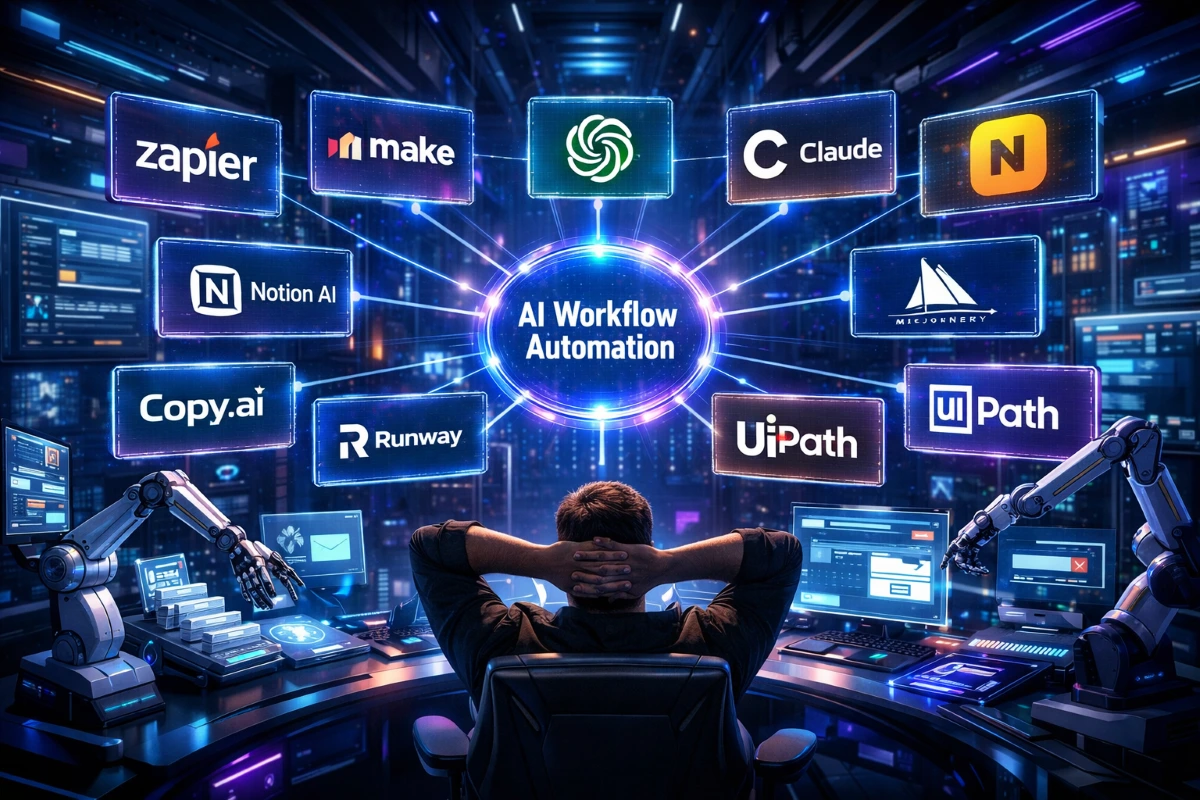
No-code tools like Zapier, Make, and Notion connected apps and reduced repetitive tasks. Rule-based workflows handled data routing, notifications, and simple triggers. Useful — but brittle.
THE AI ASSISTANT WAVE
LLMs entered the workflow — drafting emails, summarizing content, answering questions. Transformative for productivity, but still reactive. The AI did what you asked, when you asked.
THE AGENTIC INFLECTION POINT
The first production-grade AI agents arrived. Multi-step reasoning became reliable. Businesses began deploying systems that could operate independently on defined goals.
THE AUTONOMOUS BUSINESS ERA
Multi-agent systems now run entire business functions end-to-end. Specialized agents collaborate across content, distribution, analytics, and strategy.
Key Business Functions AI Agents Can Handle
Marketing Automation
Marketing has become one of the most thoroughly automated functions in a modern online business. Content agents now research trending topics, draft long-form articles calibrated to SEO intent, generate social media variants, and schedule distribution — all from a single brief. Campaign management agents monitor ad performance in real time, adjust bids, pause underperforming creative, and reallocate budget toward what’s working, often within the same hour. A business that once needed a content team, an SEO specialist, and a media buyer can now run equivalent output with a well-configured agent stack and a human strategist who checks in weekly.
Sales & Lead Generation
Sales agents have transformed the top of the funnel. Lead qualification — historically a time-consuming process of manual research and scoring — is now handled by agents that pull data from LinkedIn, website behavior, CRM history, and firmographic databases to score and prioritize prospects in real time. Outreach agents craft personalized messages that genuinely reflect the prospect’s context, not just a mail-merge template with a first name. Funnel optimization agents A/B test landing pages, analyze drop-off points, and suggest changes grounded in behavioral data. The result is a sales process that runs continuously, never takes a weekend off, and improves with every cycle.
Customer Support
The 24/7 support expectation that once required global teams or expensive outsourcing is now met by AI agents that resolve the majority of customer queries autonomously. These aren’t the brittle decision-tree chatbots of five years ago. Modern support agents understand context, access live order data, process refunds, escalate complex cases with full context pre-loaded for the human agent, and do all of this in the customer’s language. Sentiment analysis layers catch frustration early, routing at-risk customers to priority handling before a complaint becomes a churn event. Resolution rates that once hovered around 35% are now routinely exceeding 70% without human involvement.
Operations & Workflow Automation
The operational backbone of a business — task coordination, project tracking, vendor communication, internal reporting — is where agent systems deliver some of their most reliable value. Multi-agent orchestration allows specialized agents to hand off work between each other with the kind of context-preservation that human handoffs rarely achieve. An operations agent monitors project status, flags blockers, reassigns work when deadlines shift, and generates status updates without anyone asking. Backend processes that required daily human intervention now run in the background, surfacing only when a genuine exception requires judgment.
Finance & Analytics
Financial oversight, once the domain of accountants and analysts, is increasingly handled by agents that aggregate data across payment processors, ad platforms, and accounting software to produce real-time financial snapshots. Expense tracking agents categorize transactions, flag anomalies, and alert owners to unusual spending patterns. Predictive analytics agents model revenue trajectories based on current pipeline, seasonality, and historical patterns — providing business owners with the kind of forward-looking visibility that was once available only to companies with dedicated finance teams.

Real-World Use Cases of AI-Run Online Businesses
E-Commerce: The store that manages itself
Consider a Shopify-based e-commerce brand operating in the health supplements category. Its agent stack monitors inventory levels and triggers purchase orders when stock drops below threshold. A content agent generates product descriptions, blog posts, and email campaigns calibrated to seasonal demand. A customer service agent handles returns, shipping inquiries, and product questions around the clock. A pricing agent monitors competitor pricing daily and adjusts margins within pre-set parameters. The founder’s weekly involvement: two hours reviewing dashboards and approving strategic decisions the agents have flagged. Everything else runs.
Content & Media: The newsletter empire of one
A solo operator runs three niche newsletters with a combined subscriber base of 140,000. Research agents monitor industry sources daily, extracting the most relevant developments for each audience. Writing agents draft issues in a consistent voice established through extensive examples and style guides. A distribution agent handles scheduling, A/B tests subject lines, and segments audiences based on engagement history. Sponsor outreach agents identify relevant brands, draft partnership proposals, and manage follow-up sequences. The operator spends approximately three hours weekly editing final drafts and making strategic decisions about audience growth.
SaaS Business: Onboarding and support at scale
A bootstrapped SaaS product with 2,000 paying customers runs its entire support and onboarding function through agents. When a new user signs up, an onboarding agent analyzes their profile data, identifies their most likely use case, and sends a personalized onboarding sequence calibrated to their industry. A support agent resolves 78% of tickets without human escalation. A churn prediction agent monitors usage patterns and flags accounts showing disengagement signals, triggering an automated win-back sequence before the customer even considers canceling. The founding team of two remains focused entirely on product development.
Freelance & Agency: The agency that scales without headcount
A boutique digital marketing agency has restructured itself around an agent workforce. Client briefs feed into a project intake agent that creates task breakdowns, assigns work to specialized agents (SEO analysis, ad copy, social content, performance reporting), and manages timelines. The agency’s three human team members focus exclusively on client relationships and creative strategy. Output volume has tripled. Profit margins have widened significantly. And client satisfaction scores have actually improved, because turnaround times are faster and reporting is more detailed than before.
Popular AI Agent Platforms Powering Businesses in 2026

OpenAI’s Agents SDK and Custom GPTs remain the default starting point for most businesses new to agentic AI. The combination of GPT-4o’s reasoning capability, native tools like web search and code interpreter, and a maturing deployment infrastructure makes it the broadest choice for teams who want reliability over customization.
Google DeepMind’s Gemini Agents have become the dominant choice for businesses operating inside the Google ecosystem. The native integrations with Google Workspace, BigQuery, and Google Ads create a seamless agent environment that no third-party platform can replicate.
Microsoft’s Copilot Studio and AutoGen serve two distinct audiences. Copilot Studio is the enterprise no-code choice — governance-heavy, M365-native, and genuinely accessible to non-technical operators. AutoGen is its philosophical opposite: an open-source multi-agent framework for developers who want maximum architectural control.
Zapier AI Agents remain the fastest path for non-technical operators to deploy functional agents. The 7,000-plus app integrations are unmatched, and the visual interface is genuinely intuitive.
LangChain and LangGraph continue to anchor the developer community. LangGraph’s stateful graph architecture makes complex, multi-step agent workflows transparent and debuggable. For teams building custom agent pipelines they’ll maintain at scale, LangGraph is the current gold standard.
Benefits of Running an Online Business with AI Agents
- 1. Reduced operational costs. Replacing per-hour human labor with per-task AI computation fundamentally changes the unit economics of operations. Agent-run businesses consistently report 40–70% reductions in operational spend on tasks that previously required dedicated staff.
- 2. Scalability without hiring. The traditional growth bottleneck — the need to hire, train, and manage people proportionally with revenue — is broken. An agent stack that handles 100 customers can handle 10,000 with configuration changes, not headcount growth.
- 3. 24/7 execution without degradation. Human performance degrades with fatigue. Agent performance doesn’t vary with the time of day, day of the week, or whether it’s a holiday. This consistency has a measurable impact on satisfaction scores.
- 4. Faster decision-making. Agents can synthesize data, identify patterns, and generate recommendations in the time it takes a human analyst to open a spreadsheet. The businesses moving fastest in their markets are doing so because their decision cycles are shorter, not because their strategies are smarter.
- 5. Increased operational efficiency. Agents don’t context-switch, forget where they left off, or leave tasks half-done. The cumulative efficiency gain across an entire operation — no dropped balls, no repeated work, no miscommunication between functions — is larger than any individual task improvement suggests.
Conclusion: The New Era of Hands-Free Online Business
The shift we’ve traced in this piece — from manual hustle to automated operations — is not a distant trend. It is the present competitive landscape for every online business operating in 2026. The question is no longer whether AI agents can meaningfully run business functions. The evidence for that is overwhelming. The question is whether you’ll be among the operators who have figured out how to deploy them before your competition does.
The good news is that the barrier to entry has never been lower. You don’t need a developer to deploy your first agent. You don’t need an enterprise budget. You need a clear problem, a willingness to experiment, and enough curiosity to understand what you’re building before you build it. Start with one function. Observe carefully. Expand deliberately. The operators who will compound the fastest aren’t the ones waiting for the technology to mature. It already has.
The autonomous business isn’t a futurist’s fantasy. It’s your competitor’s Tuesday.