
From writing code to replacing entire workflows — here’s everything AI can do in 2026, explained clearly.
10× productivity gains reported by early enterprise AI adopters in 2026.
McKinsey estimates AI now contributes over $4.4 trillion annually to the global economy — and that number is accelerating.
Three years ago, AI could write a passable email. Today, it can run a marketing campaign, debug a full-stack application, detect cancer in a scan, and negotiate a sales deal — all before lunch.
The pace of change has been extraordinary. What felt like science fiction in 2022 is now standard enterprise software. AI in 2026 isn’t a future concept — it’s the operating layer of the modern world.
Whether you’re a business owner, developer, student, or simply curious, this is the most complete guide to what AI can actually do right now. No hype, no speculation — just capabilities, real examples, and honest limitations.
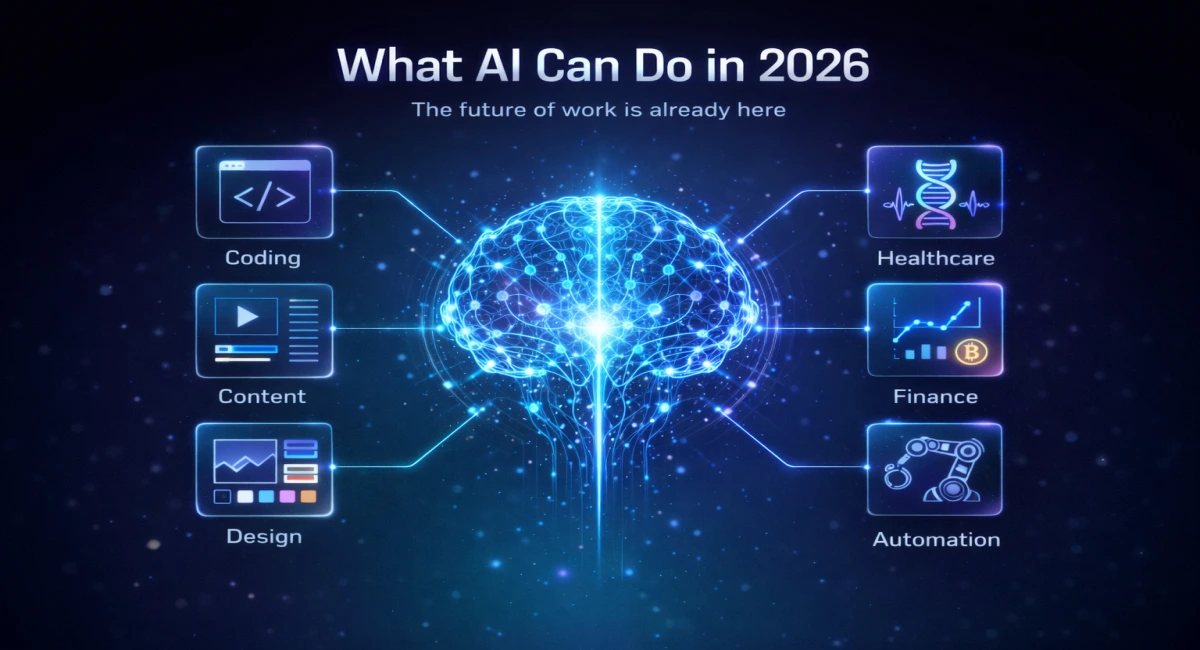
QUICK SUMMARY — KEY AI CAPABILITIES IN 2026
1. Content Creation & Writing
AI has become the world’s most versatile writer. What used to take a team of copywriters, editors, and translators now takes one prompt.
LONG-FORM CONTENT
AI tools now produce complete blog posts, scripts, e-books, and whitepapers with accurate research citations. Writers use AI as a co-author, reducing draft time from days to minutes.
SOCIAL MEDIA & SEO
Platforms generate native content like captions, threads, and short-form scripts tailored to audience tone. AI analyzes keyword gaps in real time and optimizes content for maximum search performance.
REAL-TIME TRANSLATION & LOCALIZATION
AI goes beyond translation — preserving tone, culture, and nuance. Brands can now launch globally in 50+ languages simultaneously from a single content strategy.
2. Coding & Development
The most transformative shift in 2026? AI doesn’t just help developers — in many cases, it is the developer.
FULL APPLICATION GENERATION
Describe your app in plain English and AI builds the full stack — frontend, backend, database, and deployment. Founders can now launch MVPs without writing code.
DEBUGGING & OPTIMIZATION
AI scans entire codebases, detects bottlenecks, and suggests or applies fixes instantly — reducing hours of debugging into seconds.
AUTONOMOUS AI AGENTS BUILDING SOFTWARE
Multi-agent systems now plan, write, test, and deploy software independently — while humans define goals and oversee outcomes.
3. Design & Creativity
The creative industry has been reshaped. AI generates production-ready visual assets — images, videos, UI mockups — in seconds.
IMAGE & VIDEO GENERATION
AI generates photorealistic images and high-quality videos from simple text prompts. From product visuals to full ad creatives, production is faster and more scalable than ever.
UI/UX DESIGN & BRANDING
AI tools transform wireframes into full interfaces and generate logos, color systems, and brand assets — enabling teams to design faster without compromising quality.
4. Business Automation
Entire business functions — support, sales, marketing operations — are now AI-native. The question isn’t whether to automate, but how much human oversight to keep.
CUSTOMER SUPPORT & SALES FUNNELS
AI agents handle Tier 1 and Tier 2 support across chat, email, and voice — resolving most queries without human intervention. Sales funnels operate autonomously, from lead scoring to personalized outreach and follow-ups.
EMAIL AUTOMATION & DATA ANALYSIS
AI manages inboxes, drafts replies, prioritizes messages, and summarizes conversations. It also enables natural-language analytics — letting teams generate reports and insights without writing SQL.
5. Healthcare & Science
This is where AI in 2026 becomes genuinely profound. AI is accelerating drug discovery from decades to years, and diagnosis from hours to minutes.
DRUG DISCOVERY & MEDICAL IMAGING
AI predicts protein structures, simulates drug interactions, and identifies promising molecules at high speed. In medical imaging, it detects tumors, fractures, and anomalies with accuracy comparable to experienced specialists.
DIAGNOSIS ASSISTANCE
AI supports clinicians by analyzing patient history, lab results, and imaging data — helping surface diagnoses, flag risks, and improve decision accuracy without replacing human expertise.
6. Personal Productivity
Your AI assistant in 2026 doesn’t just answer questions — it manages your time, does your research, and thinks ahead so you don’t have to.
SMART ASSISTANTS & SCHEDULING
AI assistants manage calendars, prepare meeting briefs, send follow-ups, and dynamically adjust priorities — giving you a unified and proactive view of your workday.
RESEARCH SUMMARIZATION
Analyze hundreds of pages of research, reports, or documents and get concise, cited summaries in seconds — dramatically reducing time spent on knowledge work.
7. Finance & Trading
Wall Street has been partially automated for years. In 2026, AI is moving from execution into judgment — making risk calls once reserved for senior analysts.
MARKET PREDICTIONS & RISK ANALYSIS
AI analyzes news, earnings calls, sentiment, and macroeconomic data in real time — identifying trading signals and risk patterns as they emerge. Portfolio risk models continuously adapt to changing conditions.
AUTOMATED INVESTING
AI-powered portfolio management automates rebalancing, tax optimization, and risk adjustment — enabling smarter, data-driven investing with minimal manual effort.
Real-World Examples: AI in Action
These aren’t hypotheticals. Here’s what organizations are doing with AI right now:
Limitations of AI in 2026
No honest guide would skip this section. AI is extraordinary — and it has real, important limitations that every user needs to understand.
Hallucinations
AI can generate incorrect or fabricated information. Always verify outputs in high-stakes domains like legal, medical, and finance.
Ethical concerns
Bias in training data can lead to unfair outcomes. Issues like misinformation, deepfakes, and privacy remain critical challenges.
Over-dependence
Relying too heavily on AI can weaken human judgment and critical thinking. Maintaining balance is essential.
Job displacement
Automation is replacing routine roles. Workforce reskilling and adaptation are necessary to stay relevant.
The future of AI isn’t about whether these risks exist — they do. It’s about whether we build systems, governance, and habits to manage them responsibly
What’s Next? The Future of AI Beyond 2026
Autonomous AI agents at scale: Multi-agent systems that plan, collaborate, and execute complex multi-week projects without human micromanagement. The shift from “AI as tool” to “AI as colleague” is already underway.
Human-AI collaboration as the default: The future isn’t AI replacing humans — it’s AI amplifying them. The highest-value workers in 2027 will be those who know how to direct, audit, and collaborate with AI systems effectively.
Regulation and governance: The EU AI Act is now in full enforcement. The US, UK, and China are developing parallel frameworks. How AI is governed in the next 3 years will define its trajectory for the next 30.