
What if the next global superpower isn’t a country — but an AI lab?

Three companies are quietly reshaping the future of intelligence, work, and power. This isn’t just competition — it’s a technological arms race with trillion-dollar stakes.
Who’s really winning? And why does the answer matter more than you think?
Why This AI War Is Bigger Than the Internet Boom
Every generation gets one tectonic technology shift. The printing press. Electricity. The Internet. Mobile. Cloud. Each compressed decades of human progress into a handful of years — and reshaped who held economic and political power.
Artificial intelligence is different in one critical way: it is not just a tool. It is infrastructure. Like roads, electricity grids, and fiber-optic cables before it, AI is becoming the underlying layer on which entire economies will run. The companies that control that layer will control the defaults of civilization.
The Internet boom created trillion-dollar companies. The AI race is creating something potentially larger — systems that don’t just connect information, but reason, decide, and act on behalf of billions of people. The economic implications are staggering. The geopolitical ones are more so.
Nations that built internet infrastructure in the 2000s gained decisive advantages in commerce, culture, and security. Nations that lead AI infrastructure in the 2020s will likely determine the shape of the next century. And right now, three private companies — not governments — are setting the pace.
The Key Players in the AI Battlefield
OpenAI
Built the world’s most recognized AI brand with ChatGPT. Backed by Microsoft’s deep pockets and cloud infrastructure, OpenAI prioritizes mass adoption, developer ecosystems, and relentless product velocity. Its focus: get AI into every hand, every app, every workflow.
Google DeepMind
The merger of DeepMind’s foundational brilliance with Google’s planetary-scale distribution. AlphaFold redefined biology. Gemini is reshaping search. DeepMind plays the long game — betting that whoever builds the most capable, most principled AI wins the war, even if it takes decades.
xAI
Elon Musk’s answer to what he called “woke AI.” Grok, integrated directly into X (Twitter), gives xAI a uniquely real-time, socially-connected data advantage. The mission: build a truth-seeking AI unencumbered by political caution — fast, opinionated, and deeply embedded in the world’s largest public conversation.

The Battlefronts Where the War Is Being Fought
Model Intelligence
Benchmark wars. Multimodal capabilities. Reasoning depth vs inference speed. Who has the smartest AI depends entirely on which task you’re measuring
Benchmark leaderboards shift weekly. Today’s state-of-the-art model is tomorrow’s second place. What matters long-term is not peak benchmark score, but the capability envelope — can the model reason through complex, multi-step problems? Can it understand images, audio, code, and natural language simultaneously? Can it do this fast enough to be useful?
OpenAI’s GPT series leads on broad usability and speed. DeepMind’s Gemini Ultra competes at the frontier with an emphasis on scientific and multimodal reasoning. Grok, while newer, benefits from real-time access to a firehose of public discourse — a different kind of intelligence advantage entirely.
Ecosystem Control
APIs vs platforms. Developer mindshare. Enterprise contracts. The company that owns the developer workflow owns the future application layer.
in technology, distribution beats capability. The best product rarely wins; the most embedded product does. OpenAI has captured developer imagination through its API, with thousands of applications built on its models. Google has something more powerful: default placement. When AI is woven into Search, Gmail, Docs, Android, and Chrome — used by over three billion people — adoption becomes invisible. xAI’s integration with X gives it access to the world’s real-time public conversation, a distribution moat no other lab has.
Data Advantage
Proprietary training fuel. Real-time pipelines. Legal and ethical battles over what data can be used — and who owns it.
Modern AI is only as good as the data it learns from. The web was the first training ground — and it’s mostly been consumed. The next frontier is proprietary data: medical records, legal documents, scientific papers, private enterprise data. Google’s position across Search, YouTube, and Gmail gives it a data moat of unparalleled depth. OpenAI is building partnerships with publishers and enterprises. xAI has something others don’t: a live feed of billions of human thoughts posted publicly every day.
Distribution Power
Integration into search, OS, mobile. Default positioning. The AI that reaches users first — without requiring a download — wins by inertia.
The most underrated battlefront. Microsoft’s $13B bet on OpenAI wasn’t about ChatGPT — it was about embedding AI into Office 365, used by over 400 million people daily. Google’s AI appears in search results before users even know they’re interacting with it. xAI’s positioning within X allows Grok to surface in political discussions, breaking news, and cultural moments in real time. Whoever becomes the default wins by gravity.
What This Means for Businesses, Creators, and You
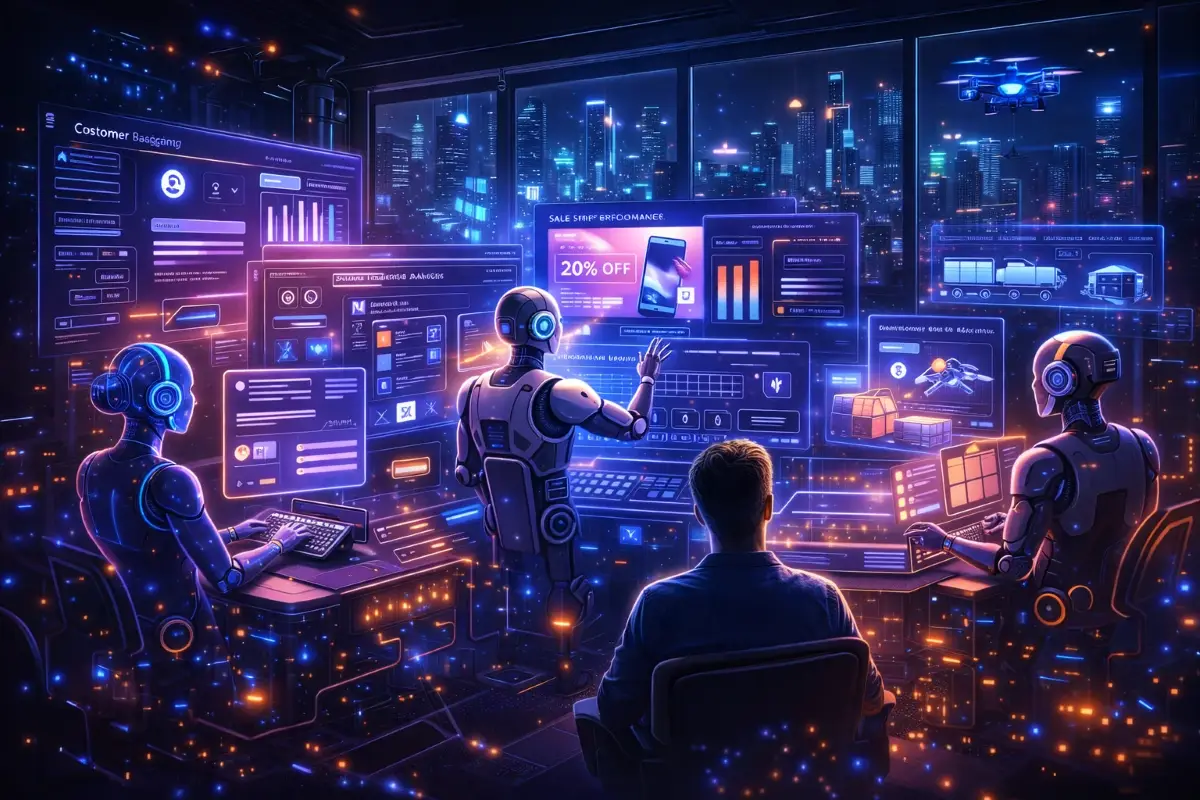
Regardless of which lab “wins,” the practical implications for individuals and organizations are already arriving.
- AI as competitive advantage.Companies that integrate AI into their workflows now are building operational advantages that compound over time. Those that wait are not standing still — they’re falling behind.
- New creation opportunities.Automation, AI agents, and content generation tools are opening categories that didn’t exist two years ago. The question is not whether to use these tools — but how to use them with intentionality and craft.
- Dependency risk.Betting your entire workflow on a single AI provider is a strategic vulnerability. Model capabilities change. Pricing changes. APIs deprecate. Diversification is wisdom.
- Job market evolution.Roles are not simply disappearing — they are transforming. The most durable skills are those that AI augments rather than replaces: judgment, creativity, relationship-building, and ethical reasoning.
- Misinformation at scale.More capable AI means more convincing synthetic content. Media literacy and source verification are no longer optional skills — they are survival tools.
The Future of the AI War (Next 3–5 Years)
The next phase of the race will look different from today’s chatbot era. Several convergences are already underway.
Autonomous AI agents — systems that don’t just answer questions but take actions in the world — will emerge as the primary battleground. An AI that can browse the web, write and execute code, send emails, book meetings, and manage projects on your behalf is not a chatbot. It is a digital employee. The lab that deploys reliable, trustworthy agents at scale wins an entirely new category.
Multi-agent collaboration is the logical next step: dozens of specialized AI agents working in orchestrated systems — one for research, one for writing, one for analysis, one for communication. The companies that build the infrastructure for these ecosystems, not just the individual agents, will capture enormous value.
Regulation vs. innovation tension will intensify. The EU’s AI Act is already reshaping how labs deploy models in Europe. US federal regulation is building slowly but will arrive. The labs that manage to remain innovative under regulatory constraints — while their less-prepared competitors scramble — will gain durable advantages.
Final Thought — This War Isn’t Just About AI
Underneath the benchmark comparisons and product launches, something more fundamental is being decided. AI systems are becoming the layer through which billions of people access information, make decisions, form opinions, and understand the world.
Whoever controls that layer controls something that has no historical precedent: the architecture of collective human reasoning. The AI war is, at its deepest level, a contest over who shapes the epistemic infrastructure of civilization — what information is surfaced, how questions are answered, whose values are embedded in the systems we increasingly rely upon.
The next global superpower might not carry a flag. It might run on a GPU cluster in a data center you’ve never heard of, trained on data you didn’t consent to share, making decisions you don’t realize are being made for you.
That’s why this war matters. Not just to investors, technologists, or policymakers — but to every person who uses the internet, reads the news, does a job, or raises a child in the decades ahead.
The war for AI is the war for what comes next. And it’s happening right now.