
This is the year AI agents crossed the threshold from experimental tools to mission-critical enterprise infrastructure. Major technology companies — Oracle, NVIDIA, Microsoft, Alibaba, Qualys, Fujitsu, and Sigma — have launched advanced agent-based platforms within months of each other, each capable of autonomous decision-making, end-to-end workflow execution, and real-time problem-solving at scale.
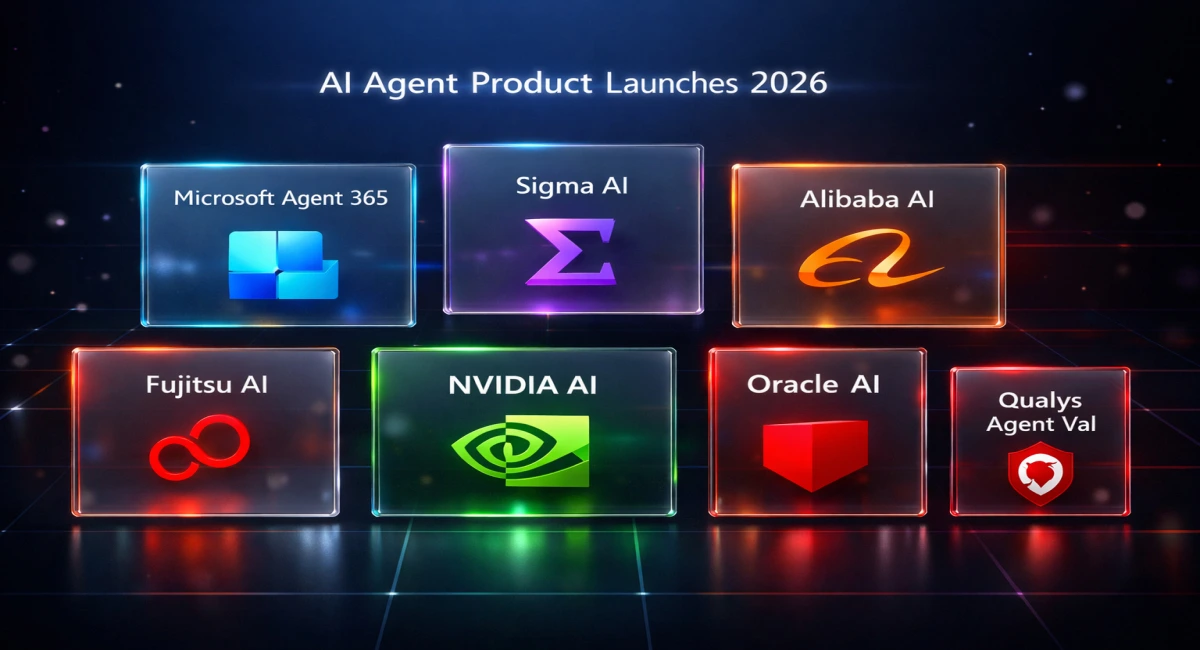
Major AI Agent Platforms Launched in 2026
Qualys Agent Val — Autonomous Cybersecurity Without Human Intervention
Cybersecurity has always suffered from a fundamental timing problem: the gap between detecting a vulnerability and remediating it is where breaches happen. Traditional security tooling identifies threats and generates alerts — but humans still have to triage, prioritize, and act. In high-volume environments, that gap can stretch from hours to days.
Qualys Agent Val closes that gap entirely.
Launched on March 31, Agent Val is an autonomous cybersecurity agent that can independently scan systems for vulnerabilities, verify threats, and implement fixes — without requiring human approval at any stage of the process. It operates continuously in the background, running detection-to-remediation cycles that previously required coordinated human workflows.
This is a meaningful architectural shift. Security operations centers have traditionally been defined by the volume of alerts they can process. Agent Val reframes the problem: instead of humans processing alerts faster, the agent eliminates the queue by acting on verified threats in real time.
For organizations facing increasing cyber threats and shrinking security team bandwidth, Agent Val represents one of the clearest arguments for autonomous AI in the enterprise. The risk of a well-governed autonomous agent acting on a verified threat is almost always lower than the risk of a human queue that moves too slowly.
Key impact: Closes the detection-to-remediation loop autonomously, reducing response time and risk exposure for enterprise security operations.

Oracle AI Database 26ai — Building Smarter, Memory-Enabled Data Agents
One of the most persistent limitations of early AI agents was amnesia. Each session started fresh. An agent that completed a complex analysis on Monday had no recollection of it on Tuesday. For enterprise applications that depend on accumulated context — customer relationships, ongoing projects, evolving data patterns — this was a fundamental barrier.
Oracle’s AI Database 26ai addresses this directly.
Launched on March 26, 26ai is built around persistent memory for AI agents — the ability to retain context across sessions, making agents progressively more intelligent and adaptive the longer they operate. The platform also includes a no-code “Private Agent Factory,” enabling enterprises to build and deploy custom agents without requiring deep technical expertise.
The implications of persistent memory for enterprise AI are significant. An agent managing a customer account can remember previous interactions, identify patterns over time, and make decisions informed by cumulative history rather than just the current session. An agent monitoring a database can build an evolving model of normal behavior, improving anomaly detection over time.
Oracle’s positioning here is deliberate: by embedding agent capabilities directly into the database layer rather than building them on top of it, 26ai makes agents native to where enterprise data actually lives.
Key impact: Persistent memory and no-code agent creation democratize AI agent deployment for large-scale data-driven enterprises.
NVIDIA NemoClaw — Open-Source Agents Move to Production
For most of AI’s recent history, a clean line separated open-source experimentation from enterprise production. Open-source models and frameworks were powerful but unpredictable — great for research, risky for business-critical applications. Proprietary enterprise platforms offered reliability but at the cost of flexibility and vendor lock-in.
NVIDIA’s NemoClaw, launched March 11, challenges that division directly.
NemoClaw is a flexible, open-source AI agent platform designed for production deployment on virtually any hardware. By removing the hardware dependency that typically constrains enterprise AI infrastructure, NemoClaw allows organizations to build and deploy workflow agents on their existing compute infrastructure — whether cloud, on-premise, or hybrid — without being locked into a specific provider’s ecosystem.
The open-source approach also accelerates innovation. Rather than waiting for a vendor to add a specific capability, development teams can build directly on the NemoClaw framework, contributing to and benefiting from a broader ecosystem of extensions and integrations.
For organizations that have been reluctant to adopt agentic AI due to vendor dependency concerns or infrastructure constraints, NemoClaw removes two of the most common barriers simultaneously.
Key impact: Bridges the gap between open-source flexibility and production reliability, enabling hardware-agnostic agent deployment for enterprises and developers alike.
Fujitsu Application Transform — Reinventing Legacy Systems with AI
Legacy modernization is one of the most expensive, time-consuming, and risky undertakings in enterprise technology. Organizations running decades-old codebases face a paradox: the systems are too critical to replace quickly, but too outdated to extend efficiently. The knowledge required to understand and document legacy code is often trapped in the minds of engineers who have long since retired.
Fujitsu’s Application Transform, unveiled March 30, applies AI agents to this problem with striking results.
The platform analyzes existing codebases and automatically generates design documentation up to 97% faster than manual methods, while improving documentation quality by 60%. This is not incremental improvement — it is a compression of months-long analysis projects into days, with higher accuracy than human-driven alternatives.
Beyond documentation, Application Transform provides the foundational analysis needed to plan modernization safely. Organizations can understand what their legacy systems actually do — often for the first time — before making architectural decisions. The AI agent essentially reconstructs the institutional knowledge embedded in aging code and makes it accessible.
For enterprises that have delayed modernization because the discovery and planning phases alone were prohibitively costly, Application Transform changes the economics fundamentally.
Key impact: Compresses legacy codebase analysis from months to days, reducing the cost and risk of enterprise modernization programs by orders of magnitude.
Alibaba Wukong — AI Agents for the Modern Workplace
While most 2026 agent launches targeted infrastructure — security, databases, code — Alibaba’s Wukong targets the layer where most enterprise work actually happens: communication, coordination, and knowledge work.
Launched March 18, Wukong is a comprehensive workplace AI platform built to handle complex natural language tasks within enterprise environments. Integrated with JVS Claw, a personal assistant agent, the platform automates communication management, task coordination, and routine decision-making — the constant overhead that fragments knowledge workers’ attention and reduces deep work time.
Wukong’s design reflects a mature understanding of how AI needs to function in real workplace environments. Rather than requiring employees to adapt their behavior to the AI — switching to new interfaces, learning new commands — Wukong integrates into existing communication and workflow patterns. Employees interact with it conversationally, in natural language, and the platform interprets and acts accordingly.
The workplace AI category has been crowded with productivity tools for years, but Wukong’s agentic capabilities — the ability to take autonomous action on tasks, not just assist with them — represent a qualitative step forward. The difference between an AI that helps you write an email and one that manages your inbox autonomously is the difference between a feature and a digital worker.
Key impact: Brings agentic AI into the core of knowledge work, automating communication and task management in a way that integrates naturally into enterprise workflows.
Sigma Agents — Governance-First AI for Data Warehouses
As AI agents move deeper into enterprise operations, a critical question follows every deployment: who is accountable when the agent is wrong? In regulated industries — finance, healthcare, legal — the answer to that question has to be clear before the first agent goes live. Many AI agent platforms have struggled to answer it convincingly.
Sigma’s governance-focused AI agents, launched in April 2026, are built around that question rather than treating it as an afterthought.
Sigma Agents operate within predefined business rules at all times, ensuring compliance and accuracy while performing automated tasks on live data warehouse environments. Unlike platforms that require significant integration work, Sigma Agents require no additional software installation — they operate within existing data infrastructure, making adoption dramatically easier for organizations that cannot afford disruption to live systems.
The governance architecture is the real differentiator. Rather than granting agents broad autonomy and then trying to audit their behavior retrospectively, Sigma bakes compliance constraints into the agent’s operating model from the start. Agents cannot take actions outside defined business rules — full stop.
For data-intensive organizations in regulated sectors, this approach resolves one of the most persistent barriers to AI agent adoption: the inability to prove control and accountability to regulators, auditors, and boards.
Key impact: Governance-first design makes AI agents viable in regulated industries and compliance-sensitive enterprise environments, where autonomous AI has previously been off-limits.
Microsoft Agent 365 — Scaling AI Agents Across the Enterprise
If most of the platforms on this list are about building capable individual agents, Microsoft Agent 365 is about something larger: managing a world in which your organization runs hundreds of them simultaneously.
Agent 365 is Microsoft’s platform for large-scale AI agent deployment and orchestration, already powering over 100 supply chain agents in early production deployments ahead of its May 2026 general availability. The platform provides centralized control, real-time monitoring, and optimization across the entire agent fleet — enabling enterprises to coordinate multiple agents working collaboratively toward shared objectives.
The supply chain use case is instructive. A modern supply chain involves dozens of interdependent processes: demand forecasting, inventory management, supplier coordination, logistics optimization, and exception handling. Managing these with individual agents — each operating in isolation — creates coordination problems that can be worse than the original manual process. Agent 365 provides the orchestration layer that allows agents to share context, hand off work, and escalate decisions appropriately.
This is the multi-agent future that the industry has been building toward: not one powerful agent, but a coordinated ecosystem of specialized agents operating under unified governance, pursuing complex objectives that no single agent could handle alone.
Key impact: Provides the orchestration infrastructure needed for enterprise-scale multi-agent deployments, moving organizations from isolated agent use cases to integrated, collaborative agent ecosystems.
2026 AI Agent Platform Snapshot
| Platform | Company | Launch Date | Primary Domain | Key Differentiator |
|---|---|---|---|---|
| Agent Val | Qualys | March 31 | Cybersecurity | End-to-end autonomous remediation |
| AI Database 26ai | Oracle | March 26 | Data & Analytics | Persistent agent memory |
| NemoClaw | NVIDIA | March 11 | Dev Infrastructure | Open-source, hardware-agnostic |
| Application Transform | Fujitsu | March 30 | Legacy Modernization | 97% faster code analysis |
| Wukong | Alibaba | March 18 | Workplace Productivity | Conversational enterprise agents |
| Sigma Agents | Sigma | April 2026 | Data Warehouses | Governance-first architecture |
| Agent 365 | Microsoft | May 2026 | Enterprise Scale | Multi-agent orchestration |
Key Trends Defining the 2026 Agent Landscape
The pattern across these launches is not coincidental. Several clear strategic trends are driving the industry simultaneously.
Autonomy is becoming the baseline expectation. The threshold question is no longer “can this AI assist a human with the task?” It is “can this AI complete the task end-to-end?” Every platform reviewed here is designed for full-loop execution — detection to remediation, analysis to documentation, request to action — without a human checkpoint in the middle.
No-code access is democratizing agent creation. Oracle’s Private Agent Factory and Sigma’s no-installation architecture both reflect a deliberate push to make agent creation accessible beyond engineering teams. The organizations that will extract the most value from agentic AI in the next two years are not necessarily the most technically sophisticated — they are the ones that can deploy agents fastest across the most use cases. Lowering the technical barrier is the mechanism.
Governance is becoming a competitive differentiator, not just a compliance checkbox. Sigma’s governance-first architecture reflects a market reality: enterprise AI adoption is being blocked less by capability concerns and more by accountability concerns. Platforms that can answer “who is responsible when this agent makes a mistake, and how do we prevent it?” will win enterprise deals that capability-first platforms lose.
Multi-agent orchestration is the next frontier. Microsoft’s Agent 365 is the clearest signal that the industry is moving past individual agent use cases. The value of agentic AI compounds when agents work together — sharing context, specializing in tasks, handing off work, and escalating appropriately. The platforms building orchestration infrastructure today are positioning themselves for the next three years of enterprise AI spending.
Open source is closing the production gap. NVIDIA’s NemoClaw demonstrates that the reliability gap between open-source and proprietary enterprise AI is narrowing. For organizations willing to invest in implementation, open-source agent frameworks now offer production-grade performance with the flexibility and cost profile that proprietary alternatives cannot match.