
Introduction
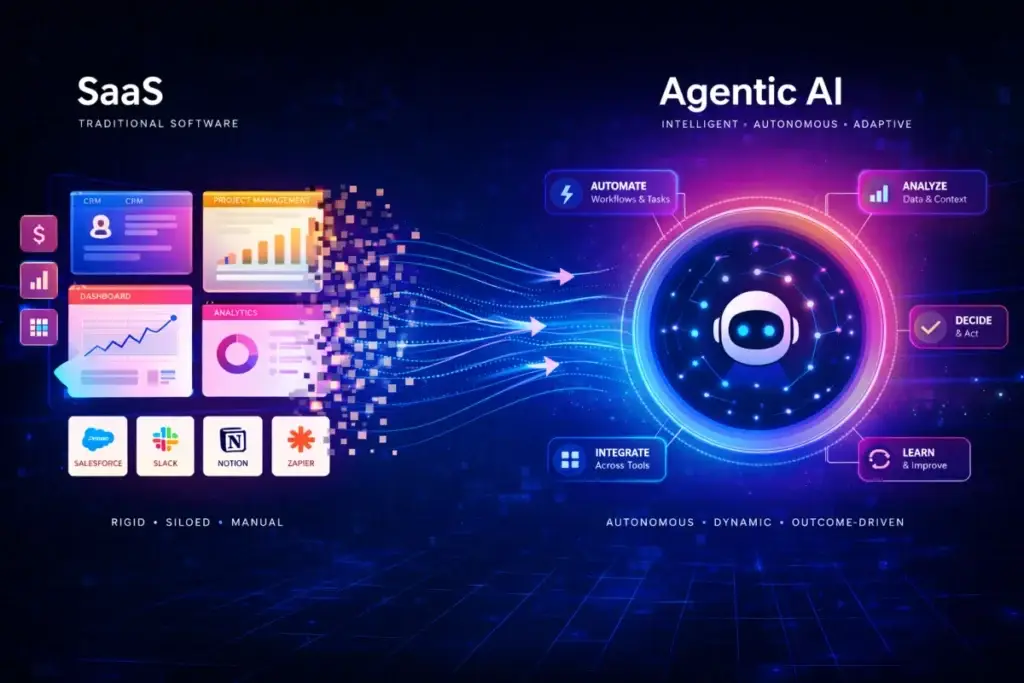
For decades, software has been defined by tools—dashboards, logins, and manual workflows. From CRMs to marketing platforms, SaaS has dominated how businesses operate. But that paradigm is shifting. We are moving from tools you operate to systems that operate for you.
Agentic AI represents this shift. Unlike traditional SaaS platforms that require constant user input, agentic systems act autonomously, make decisions, and execute tasks end-to-end. This isn’t a distant future scenario—it’s already unfolding across industries.
Thesis: Agentic AI is not merely enhancing SaaS—it is fundamentally redefining it, and in many cases, replacing it altogether.
What Is Agentic AI?
Agentic AI refers to autonomous systems designed to pursue goals and complete tasks with minimal human intervention. Its defining traits include:
- Autonomous decision-making: Agents analyze data and choose actions independently
- Goal-oriented behavior: They focus on outcomes rather than isolated tasks
- Context awareness: They adapt based on environment, history, and real-time inputs
How It Differs From Traditional AI Tools
Traditional AI tools are reactive—they wait for prompts and respond accordingly. Agentic AI, by contrast, is proactive.
- Reactive vs proactive: SaaS tools respond; agents initiate
- Prompt-based vs task-driven: Instead of waiting for commands, agents execute full workflows
Understanding the SaaS Model (And Its Limitations)
How SaaS Platforms Work Today

SaaS platforms operate on a familiar structure:
- Subscription-based access
- Interfaces (dashboards) for user interaction
- Workflows that rely heavily on manual input
Core Limitations of SaaS
Despite its success, SaaS has inherent constraints:
- Requires manual input: Users must continuously guide the system
- Tool fragmentation: Multiple platforms are needed for one workflow
- Lack of true automation: Most “automation” still depends on predefined rules
The Shift From SaaS to Agentic Systems
From Software Interfaces to Autonomous Execution
The future isn’t about better dashboards—it’s about eliminating them. Agentic systems remove the need for constant interaction.
- No dashboards
- No repetitive inputs
- Just outcomes
API-Driven Ecosystems Replacing Apps
Instead of isolated tools, agentic AI leverages APIs to orchestrate multiple systems simultaneously.
- Agents integrate services dynamically
- Workflows span multiple tools without user intervention
The Decline of “Login-and-Use” Software
Software is becoming invisible. Users no longer “use” tools—they define goals, and systems handle execution in the background.
Real-World Use Cases Where Agentic AI Replaces SaaS
Marketing Automation Without Platforms
Agentic AI can:
- Plan campaigns
- Generate content
- Execute and optimize ads
All without requiring a traditional marketing platform.
AI Replacing CRM Workflows
Agents can autonomously:
- Track leads
- Send follow-ups
- Update customer records
Reducing reliance on CRM dashboards.
Finance & Operations Without Traditional Tools
From expense tracking to forecasting, agents can:
- Analyze transactions
- Generate reports
- Predict financial trends
Eliminating the need for multiple finance tools.
Key Advantages of Agentic AI Over SaaS
End-to-End Task Completion
Agentic AI handles entire workflows, removing the need to switch between tools.
Reduced Costs and Tool Stack
- Fewer subscriptions
- Consolidated functionality
- Lower operational overhead
Continuous Learning and Adaptation
Agents improve over time by learning from data, feedback, and outcomes—unlike static SaaS systems.
Challenges and Risks of Replacing SaaS
Reliability and Trust Issues
- Accuracy concerns
- Over-reliance on autonomous decisions
Security and Data Privacy
- Agents often require broad system access
- Increased risk if not properly governed
Lack of Standardization
- Fragmented ecosystem
- No universal frameworks for agent interoperability
Impact on Businesses and SaaS Companies
SaaS Companies Must Evolve or Integrate
The shift demands transformation:
- Transition to AI-first platforms
- Embed agentic capabilities into existing tools
New Opportunities for Startups
A new category is emerging:
- Agent-native products
- Outcome-driven platforms
Changing Skill Requirements
The workforce must adapt:
- From tool operation → outcome management
- From execution → supervision of AI systems
The Future: Will SaaS Disappear Completely?
Hybrid Models (SaaS + Agents)
In the near term, hybrid systems will dominate:
- SaaS platforms enhanced with agentic layers
- Gradual transition rather than abrupt replacement
Fully Autonomous Business Operations
Long-term, we may see:

- Self-running workflows
- Minimal human intervention
- Entire organizations operated by AI systems
How to Prepare for the Agentic AI Era
For Businesses
- Start integrating AI-driven workflows
- Reduce dependency on fragmented tools
For Professionals
- Learn to manage, guide, and evaluate AI agents
- Focus on strategic thinking over execution
For SaaS Builders
- Prioritize APIs over interfaces
- Build systems designed for agent integration
Conclusion
Agentic AI marks a fundamental shift—from tools to outcomes, from manual workflows to autonomous execution. SaaS is not vanishing overnight, but it is being absorbed into a broader AI-driven ecosystem.
The trajectory is clear: software is becoming invisible, and results are becoming instantaneous.
Final thought: The companies that adapt to this shift will define the next era of technology—those that don’t risk becoming obsolete.