
Why AI Is Evolving More Quickly Than Any Innovation Before It
What took humanity decades now takes months. Understanding the forces behind the fastest technological acceleration in history.
In 1876, the telephone took 75 years to reach 100 million users. The internet needed 7 years. ChatGPT did it in two months. If that statistic doesn’t stop you mid-sentence, consider this: the AI models being trained today are not just faster — they are categorically smarter than those built twelve months ago. We are no longer watching a technology evolve. We are watching evolution itself accelerate.
Every previous wave of innovation — the steam engine, electricity, the personal computer, the internet — followed a recognizable arc: slow ignition, gradual adoption, eventual saturation. AI is rewriting that arc entirely. The question is no longer whether AI will transform every industry. The question is whether humanity can keep pace with a technology that is advancing faster than our ability to understand it.
The convergence of data, computing power, and global collaboration has created something unprecedented in the history of innovation: a technology that actively accelerates its own evolution. This is not hype. This is mechanism. And once you understand the mechanism, the speed makes perfect, terrifying sense.
The Acceleration of Innovation Cycles
To understand why AI is evolving so fast, you first need to understand how slowly everything else moved. Innovation has always built on prior innovation — but the time between breakthroughs used to be measured in generations, not quarters.
What’s driving this compression? Three forces: faster iteration loops (code can be tested, deployed, and retrained in real time), continuous deployment (unlike hardware, AI models improve remotely through updates), and global, simultaneous development (hundreds of thousands of researchers working in parallel, sharing results instantly).

The Data Explosion: AI’s Infinite Fuel Supply
Every previous technology ran on a finite resource — coal, electricity, capital. AI runs on data, and data is the only resource in human history that grows faster the more it’s used. Every search query, every purchase, every social media post, every sensor ping — all of it becomes training material for the next generation of models.
In 2023 alone, humanity generated an estimated 120 zettabytes of data. By 2025, that figure is expected to approach 175 zettabytes. To put that in context: if you stacked DVDs representing all that data, the stack would stretch from Earth to the Moon — and back — 23 times over.
“Data is not the new oil — it’s the new oxygen. And unlike oil, it never runs out.”
— The fundamental asymmetry powering AI’s rapid growthThe crucial difference lies in exponential versus linear growth. Traditional industries scale linearly: more workers, more output. Data-driven AI compounds: more data produces better models, which generate and curate more data, which trains even better models. The feedback is self-reinforcing in a way that no prior technology ever experienced.
When ChatGPT launched, it was trained on hundreds of billions of words. The models that followed weren’t just trained on more words — they were trained on conversations about AI, code written by AI, and analyses generated by AI. The training data itself became richer and more targeted with every generation.
Advances in Computing Power: The Hardware Revolution
Data alone doesn’t explain the speed of AI innovation. You need the computational infrastructure to process it — and that infrastructure has undergone its own quiet revolution.
The GPU — originally designed for video games — became the unexpected engine of the AI revolution. NVIDIA’s A100 and H100 chips can perform quadrillions of calculations per second specifically optimized for the matrix operations that neural networks require. Entire data centers now exist solely to train AI models.
Cloud computing amplified this further. Instead of waiting months to procure specialized hardware, any researcher with a credit card can now spin up thousands of virtual GPUs in minutes. What once required a major corporate infrastructure budget now costs a few thousand dollars for a weekend experiment. The barrier to entry collapsed — and innovation exploded through the gap.
NVIDIA’s latest GPU clusters can perform the equivalent computational work that would have required the world’s most powerful supercomputer in 2012 — in under one minute. This is not incremental improvement. This is a category shift.
Global Collaboration and Open Ecosystems
The Industrial Revolution spread knowledge through traveling engineers and copied blueprints. The internet spread it through websites and email. AI spreads knowledge in real time, across every continent, simultaneously — and for free.
When Google published the landmark “Attention Is All You Need” paper in 2017 — the Transformer architecture that underpins virtually every modern AI model — thousands of researchers worldwide read it within days and began building on it immediately. That paper spawned BERT, GPT, T5, LLaMA, and dozens of other foundational architectures within just a few years.
Open-source ecosystems like Hugging Face host over half a million publicly available AI models that any developer can download, modify, and improve. Meta’s decision to release the LLaMA model family sparked an entire ecosystem of fine-tuned derivatives — often built in weeks by small teams. The open-source movement turned AI R&D into a collective global enterprise that no single company or government controls.
The Self-Improving Nature of AI: The Feedback Loop
Here is where AI parts company with every technology that came before it. The steam engine could not improve the steam engine. The internet could not redesign the internet’s protocols. But AI can — and increasingly does — improve AI itself.
Large language models are now used to write and optimize code for smaller, more efficient models. AI systems generate synthetic training data to fill gaps in real-world datasets. Reinforcement Learning from Human Feedback (RLHF) creates continuous improvement loops where each model generation learns from the outputs — and failures — of the last. This is a fundamentally new kind of technological evolution.
“AI is the first technology in history that participates in its own evolution. It is not merely a tool — it is becoming a collaborator in its own development.”
AlphaCode, DeepMind’s AI programming system, can generate code competitive with human developers. GitHub Copilot now writes substantial portions of the code used to build the next generation of AI systems. The recursive loop is tightening. Each cycle produces better tools, which produce better AI, which produces better tools — faster and faster.
Business and Market Pressure: The Race Nobody Can Afford to Lose
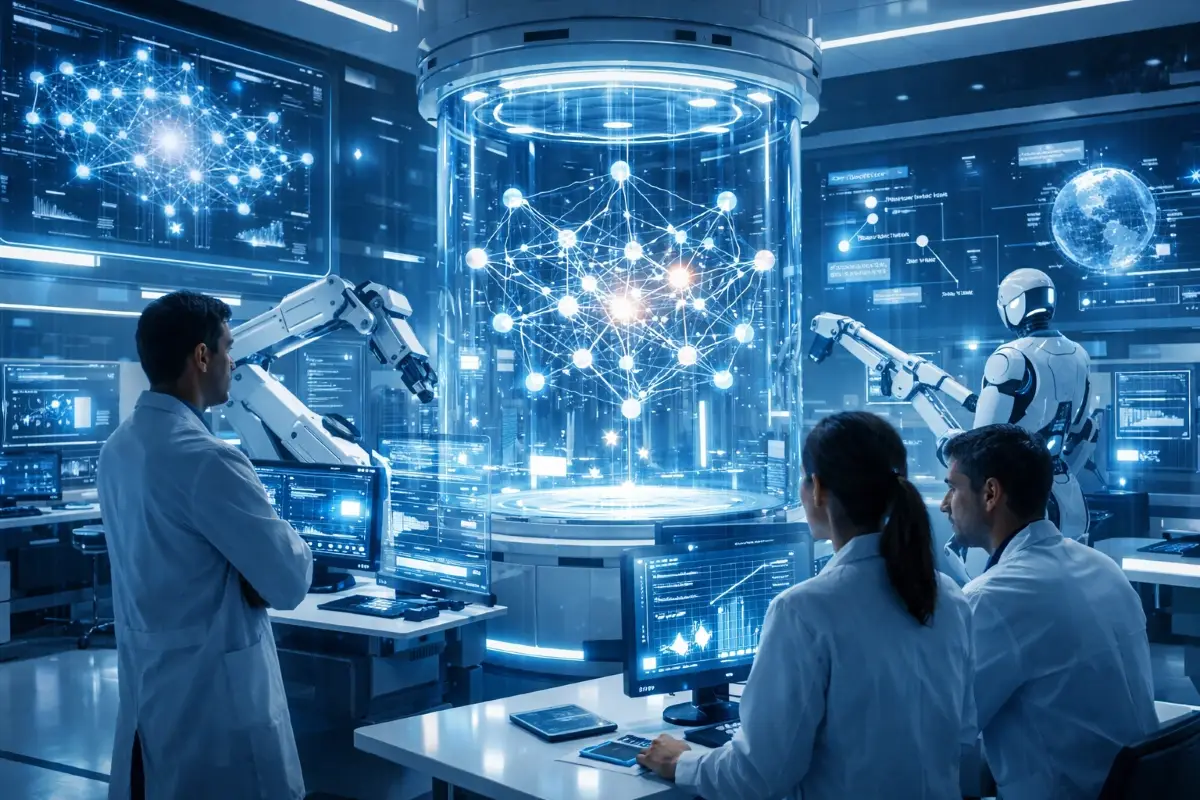
Technology evolves faster when the stakes are existential — and for the world’s largest companies, the AI race feels precisely that way. Microsoft’s multi-billion-dollar partnership with OpenAI, Google’s emergency restructuring around Gemini, Amazon’s massive Anthropic investment, Meta’s open-source LLaMA strategy — these are not bets on a promising technology. They are defensive maneuvers against potential obsolescence.
Global AI investment surpassed $200 billion in 2024. Startups that would have taken years to build in previous technological eras are being funded, launched, and scaled within months. The competitive pressure creates a ratchet: every breakthrough forces competitors to respond, which creates new breakthroughs, which demand more responses. There is no pause button.
The fear is rational. A company that falls even eighteen months behind in AI capability may find its core product commoditized, its talent poached, and its market share eroded — all before its leadership team fully understands what happened. This dynamic does not slow innovation. It detonates it.
The Risks of Rapid Evolution
Speed without direction is not progress — it is risk. The same forces accelerating AI’s rapid development also compress the time available to understand, govern, and adapt to its consequences. The risks are real and deserve clear-eyed acknowledgment.
-
Ethical Blind Spots When development cycles last months, the ethical review that might take years in other industries simply doesn’t happen. Bias, hallucination, and misuse are discovered after deployment — at scale.
-
Workforce Displacement AI automation is targeting white-collar knowledge work for the first time — legal analysis, coding, content creation, financial modeling. Unlike previous automation waves, retraining cannot keep pace with the speed of displacement.
-
Regulatory Lag Governments worldwide are attempting to regulate a technology that evolves faster than legislative cycles. The EU AI Act took years to draft — the technology it governs has already been superseded multiple times.
-
Security and Misuse Highly capable AI tools with minimal safeguards can generate disinformation, synthesize dangerous information, or enable cyberattacks at unprecedented scale and speed.
These are not arguments against AI. They are arguments for intentional, informed engagement — understanding enough about the technology to participate in shaping its trajectory, rather than simply being subject to it.
Future Implications: What Comes Next
If the last five years represent an extraordinary acceleration of AI growth speed, the next five may represent something harder to comprehend. The models being trained today are learning not just from static text — but from video, audio, sensor data, scientific literature, and real-time web information simultaneously. The next frontier is not smarter chatbots. It is AI that reasons, plans, and acts autonomously across multi-step, real-world tasks.
Industries that seem secure today — medicine, law, engineering, education — will experience the disruption that media, retail, and customer service faced a decade ago. New industries will emerge around AI oversight, AI training, and AI-human collaboration that we cannot yet name. The innovation cycles will only shorten further.
Researchers project that by 2027, AI systems may be capable of performing the majority of remote knowledge work tasks that currently require a college degree. Whether this creates abundance or crisis depends entirely on how intentionally societies choose to navigate the transition — starting now.
The most important implication may be this: continuous adaptation is no longer a career strategy. It is a survival requirement. The half-life of specific technical skills is shortening. The ability to learn, unlearn, and relearn — faster than the technology itself — is becoming the defining human competency of the age.
What You Should Do Right Now
Understanding that AI is evolving fast is passive. Here is how to move from observer to participant:
You don’t need to be an engineer. Understand how large language models work, what they can and can’t do, and where the boundaries of current AI lie. Free resources from fast.ai, Google, and Coursera cover the essentials in hours.
The professionals thriving in an AI-accelerated world aren’t the ones who understand AI most deeply — they’re the ones using it most fluidly. Start with one tool (writing, coding, research) and go deep before going broad.
Subscribe to one reliable source — Anthropic’s blog, OpenAI’s research page, MIT Technology Review’s AI coverage, or The Batch from deeplearning.ai. One quality newsletter per week is enough to stay meaningfully informed.
Inform yourself about AI regulation debates in your country and industry. The people shaping how AI develops need to include voices beyond the tech industry — including yours.
The Question Is No Longer Whether AI Will Change Everything. The Question Is Whether You’re Ready.
Every generation in history has lived through a transformation that seemed overwhelming in the moment — and obvious in retrospect. The Industrial Revolution disrupted agrarian life. Electrification rewired cities and economies. The internet dissolved the boundaries of information and commerce.
AI is not the next item in that list. It is a different kind of item entirely — because unlike every previous transformation, this one doesn’t wait for human institutions to catch up. It doesn’t pause while regulators deliberate or educators redesign curricula.
The companies and individuals navigating this transition successfully are not the ones with the most resources or the most technical knowledge. They are the ones with the clearest understanding of what is actually happening — and the intellectual courage to act on that understanding before consensus has formed.
Progress used to mean moving forward. AI is redefining what forward even means.